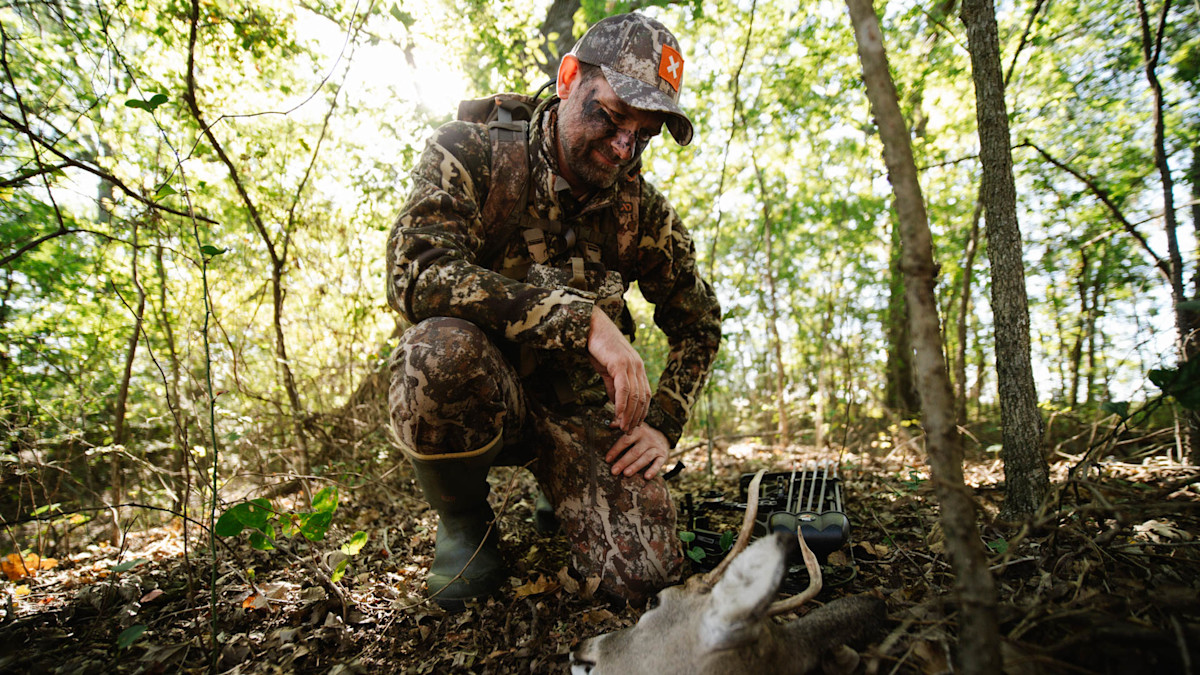

I was nine years into my public land hunting career when I first dipped my toe in the target-buck pool. The North Carolina hitlister showed up on my trail cameras just before Halloween, with pre-rut in full swing, and a gnarly heat wave set to roll in a week later.
With nearly a decade of experience in my rearview mirror, I made one of the dumbest hunting mistakes of my life—I stayed home on November 7. The temps hit 80 degrees, and I convinced myself that the deer would sit tight until dark.
Guess who cruised by my stand camera mid-morning?
I know what you’re thinking. Duh, that’s peak rut. There’s no weather on Earth that justifies sitting it out, because bucks will move regardless. It’s a fair point, but that experience reframed my entire attitude towards hunting in unexpectedly warm weather all season long. It should do the same for you.
Nature’s Air Conditioning
For most September whitetail openers, heat is inevitable. Deer are still munching on leafy greens in their summer coats, and a 10-degree increase from one day to the next isn’t likely to change their pattern much.
Flip a page or two on your calendar, and that 10-degree swing becomes something noticeable for deer that have put on a solid layer of fat and fluff. This is true over most of the whitetail’s range; even in the South, where it’s not uncommon for early-summer temperatures to reappear throughout the winter.
I stared for way too long at that daylight photo of the buck I named “Tank” when it dawned on me. He was panting his way to the creek below my stand. Even in late October, the temps forced that buck to search for water. Again, that probably sounds like a “duh” moment. In my defense, public land whitetail hunting is full of lessons that smack you in the head like a bucket of wet concrete and make you question your own intelligence.
I knew Tank spent most of his time on neighboring private land, where there was textbook bedding cover and no shortage of farm ponds to sip from. But a huge percentage of public land across the country consists of riparian corridors and floodplains—and that spot was no different. A low area along a body of water with a closed canopy and an open, breezy understory. All of which adds up to sweet relief for an overheated buck.
For years, I focused on the unique food sources available in those bottomland hardwood forests as primary drivers of daytime deer traffic from private to public, like old-growth white oaks, persimmons, and all kinds of juicy forbs that upland private parcels rarely offer. It took that missed connection with Tank for me to realize the leverage those areas also held as thermal refugia during fall and winter heat waves.
I filed that lesson away for the next temperature surge and quickly realized there was another advantage to braving warm weather on public land. One that followed the thought process of the average weekend warrior.
Snowbird Mentality
Because the South is second only to New England in terms of human population density, a lot of public land in the region is inherently tight to development. Knowing how to play off private land pressures is a huge advantage for a Southern public land hunter.
The season prior to my fumble with Tank, I noticed that I generally saw more deer activity on weekends compared to weekdays, and I anecdotally attributed that to people working on neighboring private lands where most whitetails in the area were bedding. More than once, I heard a chainsaw or lawnmower fire up and had deer show up minutes later. Once I started deliberately hunting heat waves, I realized a similar pattern was also working in my favor.
Consider the temperatures most folks set their thermostats to. Usually somewhere in the neighborhood of 72 degrees, because that’s what human biology says is most comfortable for rest and relaxation. Coincidentally, that was a common temperature range for post-October warm fronts in central North Carolina. And the non-hunting residents, sick of being cooped up in cold weather, responded accordingly.
Weekday or weekend, if the mercury was too high by my standards as a whitetail hunter, I could bet that the masses would be out enjoying the sunshine and incidentally pushing deer my way. I could also bet that I’d pretty much have the woods to myself, because most of my competition was waiting on the next frost.
Cold Front or Bust?
The venn diagram of deer hunters and people who are obsessed with cold fronts is probably close to a perfect circle. I’m not saying anyone is wrong for feeling that way, because cold fronts can be incredible if you hunt them the right way. The problem is, that’s among the most common knowledge in the whitetail world. Anyone with an ounce of skin in the game is likely to hit the woods when the temperature drops.
I consider myself a pretty gracious public land hunter. I’m happy to share the land with other sportsmen and women because I want this lifestyle to persist despite the modern world constantly pushing away from it. But I also don’t love running into other hunters while I’m trying to fill a tag.
It’s nothing personal; I just prefer the feeling of solitude and whitetails that aren’t on edge from overwhelming hunting pressure. Hunting in warm weather might not feel great, but it’s a surefire way to separate yourself from the cold-front crowds. And you’ll probably find that it’s worth the extra sweat on your brow.
Stay in the loop with The Wired to Hunt Newsletter
Shop
Related
Hunt
Ask Wired to Hunt: Processing Deer in Warm Temps

Hunt
3 Hot Weather Deer Hunting Myths