
Lever action hunting rifles remain a staple at deer camps, not just because they’re especially nostalgic, but because they’re quick, smooth handling rifles. For those reasons alone, they’re incredibly relevant even in a time of featherlight, long range rifles. A few years ago, Marlin (under the ownership of Ruger) released their Dark Series line of lever action rifles. They started with the 1895 .45-70 Govt. and have since introduced others, including the classic 336 in .30-30 Win.
Diehard lever fans might view this modernization as blasphemous, while others will embrace the power (and utility) of the dark side. After recently getting my hands on one, I recognize the appeal. If nothing else, it’s a testament to the rifle’s platform.
Specs and Features
Cartridge: .30-30 Win. Capacity: 4+1 Weight: 6.9 lb. Stock: Nylon Reinforced Polymer Thread Pattern: 5/8"-24 Barrel Length: 16.17” Overall Length: 35.5” Twist: 1:11” Mount: Mid-length Pic Rail Front Sight: Tritium Fiber Optic Rear Sight: Adjustable Ghost Ring Price: $1519
The tacticool components of the .30-30 Dark Series make an already handy rifle even more so, and I say that as someone who’s owned several 336s over the years. It might not look like a classic cowboy action, but these two seemingly different styles wed together nicely. Let’s start with the obvious.

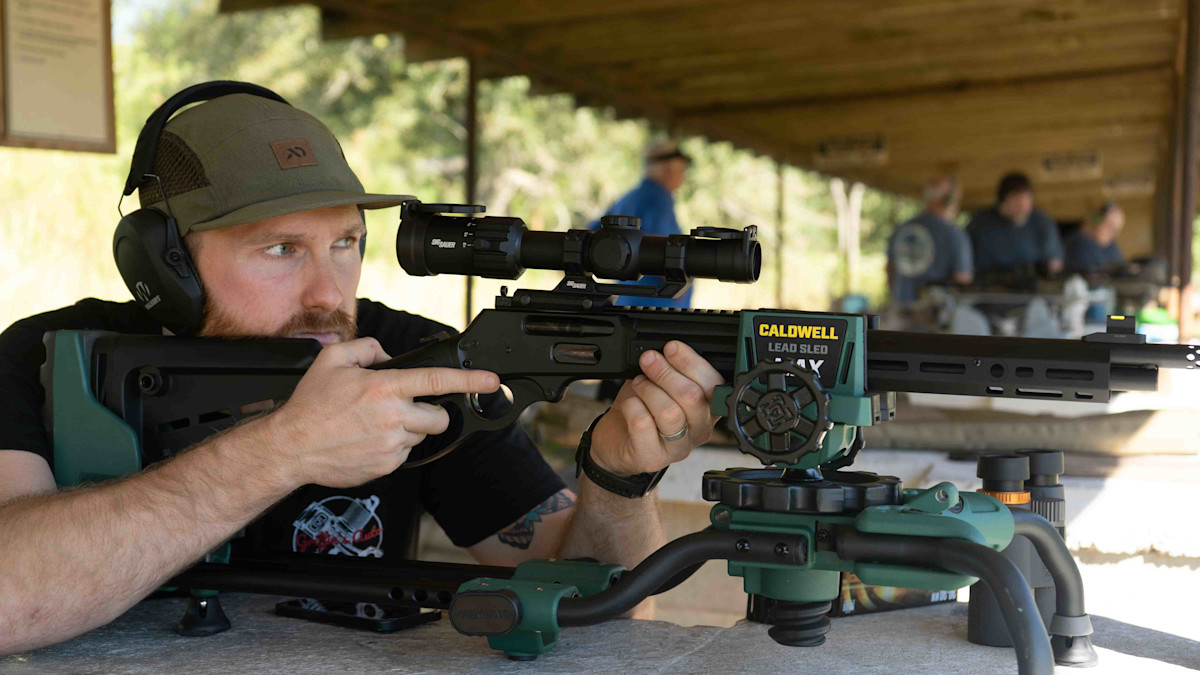
Its mid-length Pic rail allows for several different mounting options for a full size or LPVO scope or a red dot, and it comes stock with an adjustable rear ghost ring and front tritium sight combination. I’m a huge fan of ghost ring sights, but I’d like to see one with a smaller diameter here. This one makes for quick target acquisition but probably at the cost of better groups. You likely won’t be stretching this gun beyond 150 yards, so a smaller rear sight would help with accuracy in a short-range cartridge with an even shorter barrel.

Marlin also swapped out the classic walnut furniture for a polymer stock and anodized aluminum forend, both of which feature flush cup sockets for QD sling swivels. There are also plenty of M-LOK attachment slots along the forend and a few on the stock, so you can customize it with other accessories. Marlin also includes a cheek riser for the stock, so you can adjust it depending on your choice of optic and mounting options.
The 336 Dark Series also comes with a sharp graphite black Cerakote finish, while the bolt and lever feature a nitride finish to preserve the moving parts that see the most action. The loading gate also functions smoothly, and I never got pinched loading or unloading the rifle.

At the Range
Unlike typical gun reviews that place a huge emphasis on a rifle’s ability to group shots at 100 yards, that wouldn't exactly be true to the 336 Dark Series’ purpose. It’s still a metric to consider, just not the determining factor for this particular rifle. Instead, I placed most of the emphasis on its handling, especially for close-quarter shooting situations (within 100 yards). I even conducted a sight/optic test to see how quickly and accurately it functioned with open sights, a LPVO scope, and a red dot. You can read that in-depth breakdown here.
As someone who owns several and regularly hunts with lever actions, I was eager to see how the 336 Dark Series handled. While conducting the sight/optic test, I shot the rifle from a standing position, starting with the gun at a low hold, then quickly mounting it, and firing three shots as fast as possible. Even without the included cheek riser, the 336 dark series provided a natural cheek weld with all three optics, especially the iron sights. I did have both the red dot and LPVO scope mounted low. Anything higher than this would probably require the cheek riser or force you to lift your head off the stock’s comb.

With a 16-inch barrel, the 336 Dark Series is nimble. While I didn’t use a silencer during testing, the added length still wouldn’t detract from how quickly you can maneuver it around obstructions or brush. That kind of quickness it’s ideal for a rifle in thick timber.
The midsize finger lever also allows you to quickly cycle the gun with just a tad extra wiggle room. The .30-30 is already a mild recoiling cartridge, but the plush recoil pad and muzzle break reduce that even more. I was able to quickly cycle the three-shot groups without any hiccups and get back on target. I even did a few mag dumps at 100 yards while shooting from a kneeling position and never had a cycling issue. I might have even done a few extra mag dumps because this rifle is just plain fun to shoot.

There is a bit of creep in the trigger, but that’s another lever gun trademark. It’s noticeable, but certainly not unbearable. The barrel does get hot after quickly emptying the mag a few times, and the aluminum forend soaks up all that heat. However, you shouldn’t worry about that type of volume shooting in a typical hunting scenario. If you do, you probably have much bigger problems.
Accuracy
I still subjected the 336 Dark Series to the usual rifle review testing. I shot three different loads in five three- and five-shot groups at 100 yards. I then recorded the best group and the average group size for all three- and five-shot groups. For optics, I chose a Sig Sauer TANGO-MSR 1-6x24, which fits the bill for the 336 Dark Series’ purpose.
As you can see from the table below, the 336 performed best with Hornady’s 140 gr Monoflex. It averaged a 0.92-inch group (three-shot) and 1.87-inch group (five-shot) at 100 yards. The best single groups were a 0.89-inch and 1.28-inch group for the three- and five-shot groups, respectively. Those numbers are on par with what you should expect from a lever action. The discrepancy between the three- and five-shot groups is also worth noting. The average more than doubled, and the gun consistently produced flyers after three shots in every group and load.

For the Winchester 150 gr Power Point and Federal Premium Hammer Down 150 gr, those average groups came to 1.3 (three-shot) and 2.34 (five-shot) and 1.06 (three-shot) and 2.43 (five-shot) inches, respectively. Lever actions aren’t known for their accuracy, and this much was to be expected with round nose bullets. But, if you’re talking about hitting the boiler room on a deer, it’s accurate enough.
| Hornady 140 gr Monoflex .30-30 | Winchester Power Point 150 gr .30-30 | Federal Hammer Down 150 gr .30-30 | |
|---|---|---|---|
| 3-Shot Best Group | 0.89" | 0.74" | 0.68" |
| 3-Shot Avg | 0.92" | 1.30" | 1.06" |
| 5-Shot Best Group | 1.28" | 1.76" | 1.76" |
| 5-Shot Avg | 1.87" | 2.34" | 2.43" |

Last Shot
A few years ago, Jordan Sillars reviewed the Ruger-Made Marlin 336, and highlighted the level of craftsmanship in the revived lever action. I’m sure there are a few contrarians, but there’s a broad consensus that Ruger redeemed the 336 after the “Remlin” years. You’ll still find a cross-bolt safety on the receiver. More than once I squeezed the trigger only to hear a “ting,” so don’t forget to disengage it when you have a buck in your crosshairs.
No, this isn’t your grandfather’s lever action, and it’s definitely not the price tag your grandfather would have paid either. At $1500, this rifle isn’t cheap, especially with underwhelming (five-shot) groups. Of course, that might not matter to lever gun enthusiasts or collectors who favor a well-crafted and handling rifle.
Stay in the loop with The MeatEater Newsletter
Shop
Related

Firearms
A Classic Reborn: Ruger-Made Marlin Model 336 (Full Review)

Gun Reviews
Not Your Grandpa's .30-30: Marlin 336 Dark Series Review