
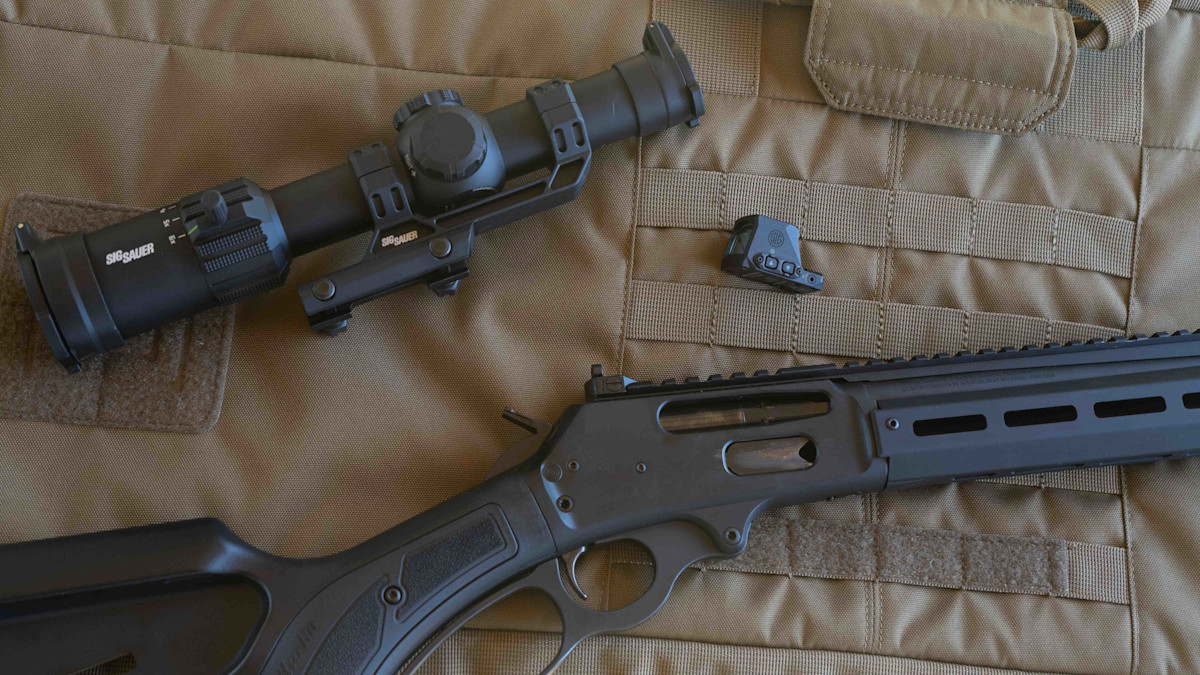

Most hunters don’t think twice about mounting a scope on their deer rifle. It’s a given. Manufacturers stopped including iron sights decades ago, except on lever actions or those earmarked for dangerous game. With the buffet of highly capable scopes at every price tier, it’s easy to see why. If you can quickly dial your scope from 2x to 15x why wouldn’t you want that option?
That wide range of shootability makes it easy to pop a deer within bow range or two poles down on a power line. But what about when you’re still-hunting and a buck jumps up at 20 yards? It can be almost impossible to find him if your scope is cranked all the way up, and by the time you dial it down, he’s gone. Iron sights might give you the advantage there, and a red dot probably offers you the best opportunity.
Nowhere is this debate more contested than at deer-dog camp. You’ll find an even mix of scoped rifles, iron sights, and even red dots. Each hunter believes that their setup provides the best opportunity for shooting deer as they trot through a creek bottom or sprint across a clear cut. An argument could be made in favor of any of the three. But are iron sights really the best for quick, close shots?
I decided to test all three against one another, and the results might not be as clear-cut as you’d think. Before I dive into the test results, let’s look at the pros and cons of each.
Iron Sights
The most durable of the three, iron sights won’t send you packing just because your rifle takes a tumble. You can drop your rifle and your iron sights will still function. Of course, this depends on the quality of iron sights. Some are incredible, others are a liability. Sights held by a few flimsy screws tend to fall into the latter category. My favorite option is a Williams Foolproof Receiver Sight (ghost ring), which I have mounted on my personal favorite rifle and use every season. The small peep diameter and plethora of micro adjustments can give you surprising utility within a few hundred yards. My personal claim to fame is a buck I took at 162 yards with a Williams rear peep sight on a Savage 99 .308 Win. That’s more of a testament to how effective iron sights can be, rather than my shooting abilities.
They also offer you the best field of view, so you can easily locate a deer that explodes out of a brush pile without worrying about dialing your scope down or trying to find a buck sprinting through the timber. Of course, iron sights aren’t ideal for low light conditions, which happens to coincide with peak deer movement.
Red Dots
Red dots, whether they’re enclosed or open reflex sights, offer similar utility as iron sights with the added benefit of an illuminated reticle or dot, making target acquisition slightly quicker and more forgiving when you aren’t in the most optimal shooting position. You simply put the red dot where you need your bullet to hit and shoot.
Unlike iron sights, red dots are the least dependable. Most of them, especially enclosed or tube style, are durable, but a lot of them depend on a battery. If you’re going to run one on a hunting rifle, make sure you keep a few spare batteries in your pack or the tools to quickly pull it off your gun should it fail. While I’ve never had an issue with open reflex sights, you can always go with an enclosed or tube style red dot for extra assurance.
Scopes
I won’t spend a ton of time on scopes because the benefits are too obvious and the drawbacks too few. In just about any deer hunting scenario, a rifle scope gives you the edge. There’s the obvious shooting capability from zero to several hundred yards, and it’s no contest when it comes to lowlight situations. Unless you drop your rifle out of your treestand, it actually takes a lot more than you think to knock your scope of zero. That doesn’t mean you won’t find scenarios where a red dot or iron sights have an advantage on scopes, but you can look at the data and decide for yourself.
Iron Sights VS. Red Dots VS. Scopes
It’s often stated that iron sights are best for quick, close-quarter shots, implying that scopes aren’t ideal for that scenario. But is that actually true?
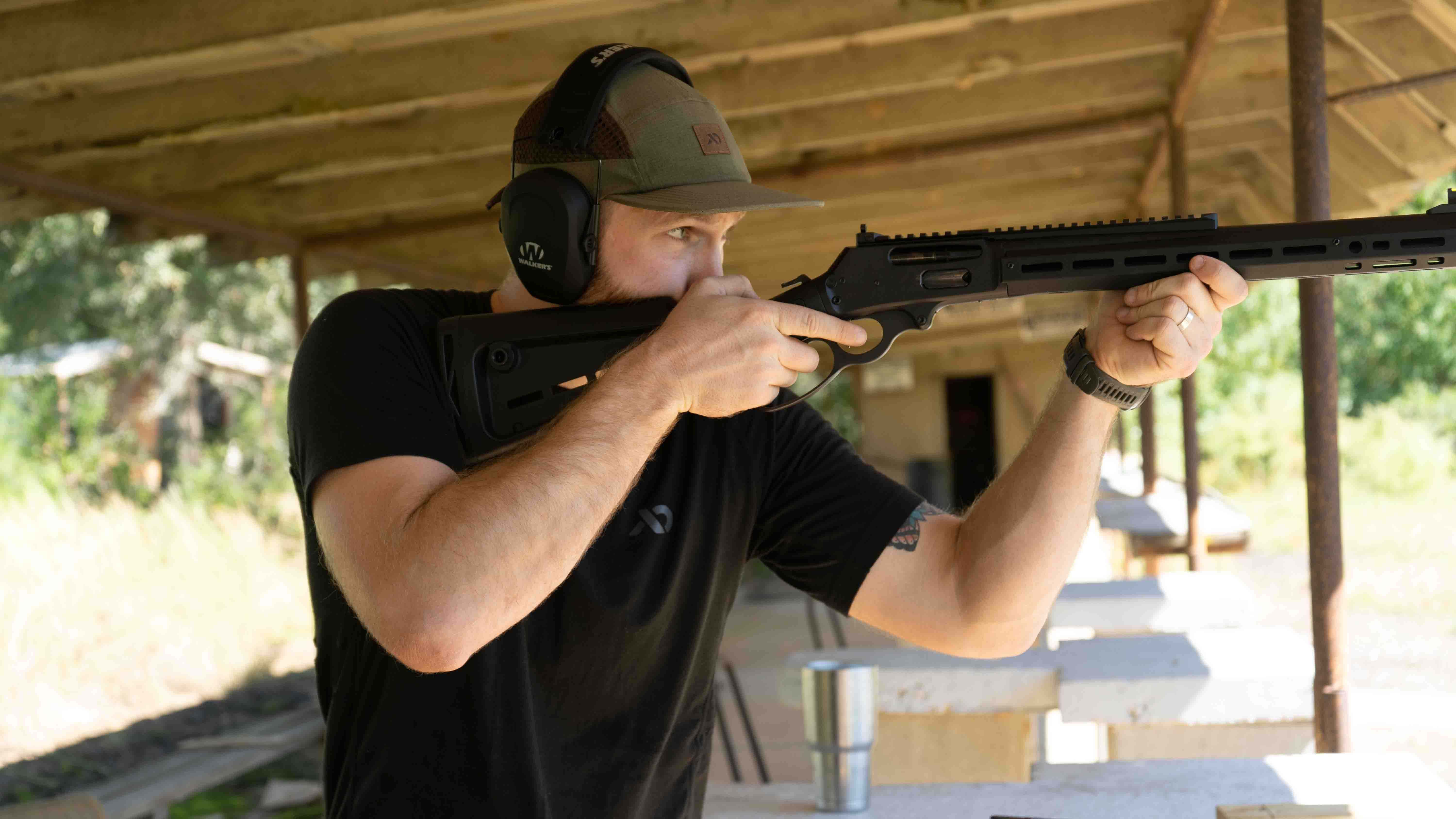
To see how iron sights compared to both red dots and scopes for quick, offhand shots, I ran all three of them through a shooting drill with a Marlin 336 .30-30 Dark Series. I decided to use Winchester 150 gr Power Point for the test ammo, since that’s the kind of ammo most hunters use with a lever action .30-30. To keep it as realistic as possible, I kept the scope on 6x, which is where I typically set a rifle scope when I’m still-hunting timbered areas.
As someone who regularly still-hunts with all three of these sights/optics, I was intrigued to see how they stacked up. For the shooting drill I conducted three three-shot groups at both 25 and 50 yards, moving the rifle from a low position to mount and then firing. I shot from a standing, freehand position to try and mimic a hunting scenario. I used an IPSC shot timer to record each shot sequence. I then recorded the average shooting time and the best three-shot group. Here’s what the test revealed.
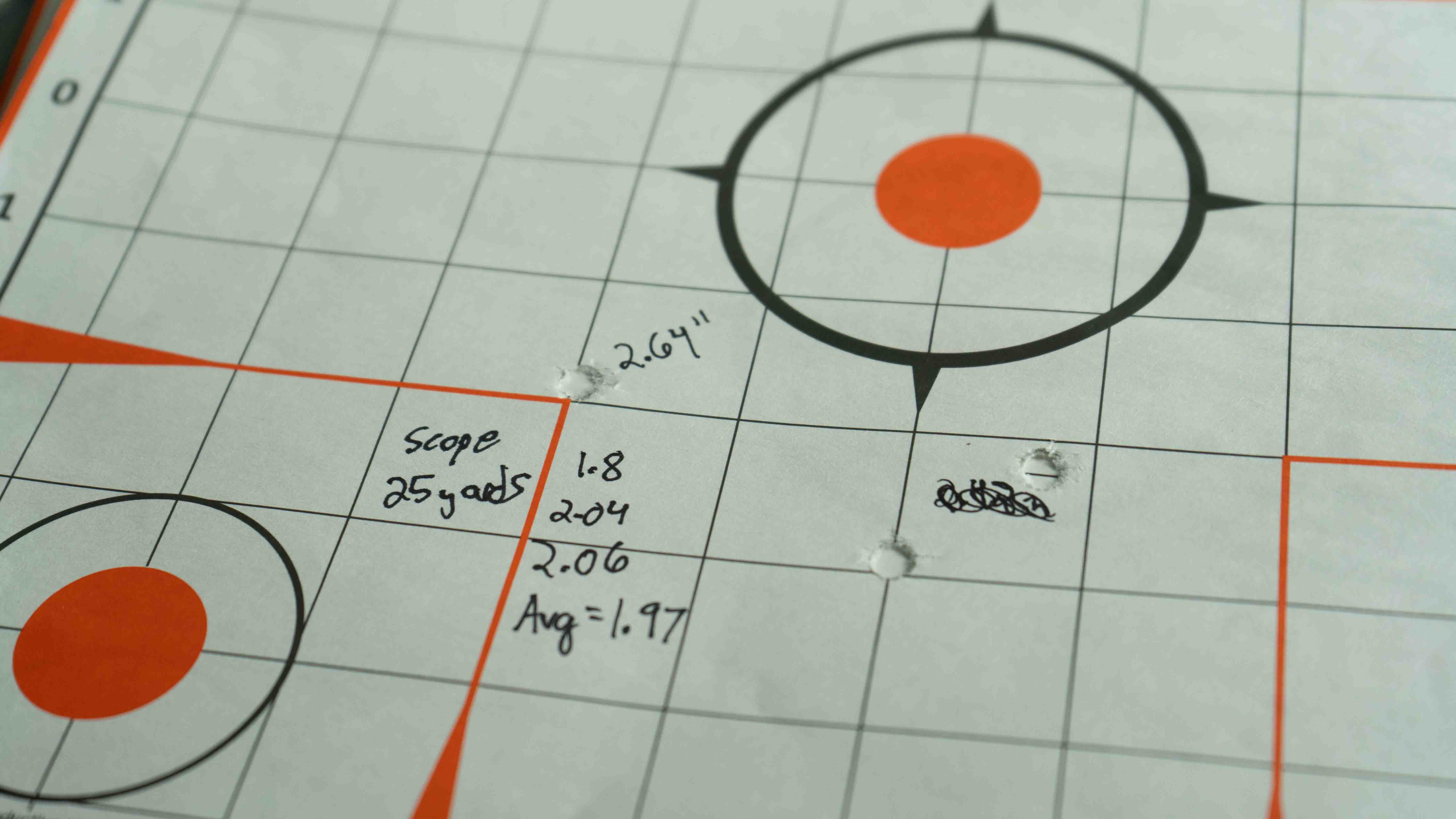
At 25 yards the scope and open sights miraculously tied with an average shot time of 1.97 seconds, but the scope produced the best three-shot group at 2.64 inches. While the open sights provided a similar shot time, the three-shot group jumped to 3.23 inches. After that, the red dot came a tad slower with an average of 2.06 seconds but produced a solid 2.70-inch group.
The results were similar at 50 yards. The red dot took a marginal victory with an average shot time of 2.18 seconds and a 2.78-in group. Iron sights followed with 2.52 seconds and a 3.48-inch group, while the scope brought up the rear with 2.94 seconds and a 3.93-inch group. Again, these are times and groups done from a standing, low position to mount, not from a bench. Get sub-MOA out of your head. These are closer to shooting situations you might encounter in the woods, not from a benchrest.
| Scope | Iron Sights | Red Dot | ||||
| Range | Average Shot Time | Best Group Size | Average Shot Time | Best Group Size | Average Shot Time | Best Group Size |
| 25 Yards | 1.97 sec | 2.64 in. | 1.97 sec | 3.23 in. | 2.06 sec | 2.70 in. |
| 50 Yards | 2.94 sec | 3.93 in. | 2.52 sec | 3.48 in. | 2.18 sec | 2.78 in. |
The Takeaways
Even with this small sample size, it’s clear that you can achieve similar results with any of these sight/optic choices. Getting at the original question–are iron sights best for quick, close quarter shots? Based on the average shot times and groups, not necessarily. Looking at the 50-yard results, the times fall within less than a second of each other and about an inch difference for the group sizes. For hunting purposes, that minutiae of difference is unnoticeable to most hunters, especially when you’re aiming at a deer’s vitals, not the center of a target.
It’s impossible to replicate the psychological stress of jumping a big buck, and it’s possible that a moving target might skew these numbers. Still, it’s hard to say if they’d be meaningful enough to suggest that one is significantly worse than the others.
I'll make one caveat for the iron sights. The diameter of a rear ghost ring sight can absolutely make a difference in your shooting accuracy. A smaller rear sight will generally offer more accurate shooting, especially at farther distances.
So what does it mean for hunters?
The next time you want to still-hunt, join a deer drive, or ride along for a deer-dog hunt, you don’t need to worry about reaching for your gun with iron sights. You certainly can and should feel confident doing so, but it’s not going to give you an unparalleled advantage.
And if you’ve been wanting to put a scope on your grandpa’s lever action but thought against it, you can feel confident that putting a low power variable scope on it won’t diminish your quick, offhand shooting capabilities. It will, however, give you an advantage in low light shooting situations. Just remember to crank your scope back down to 5 or 6x while you’re walking.
Regardless of which sight/optic you choose, practice with your setup if you plan on shooting running game. My groups definitely got faster and smaller the more I shot. And that might be the biggest takeaway yet.
Stay in the loop with The MeatEater Newsletter
Shop

Related
Hunting Gear
Iron Sights vs. Scope vs. Red Dot: Which Is Fastest?
Firearms
Video: Red Dot Turkey Sights in Jani’s Gear Shed

