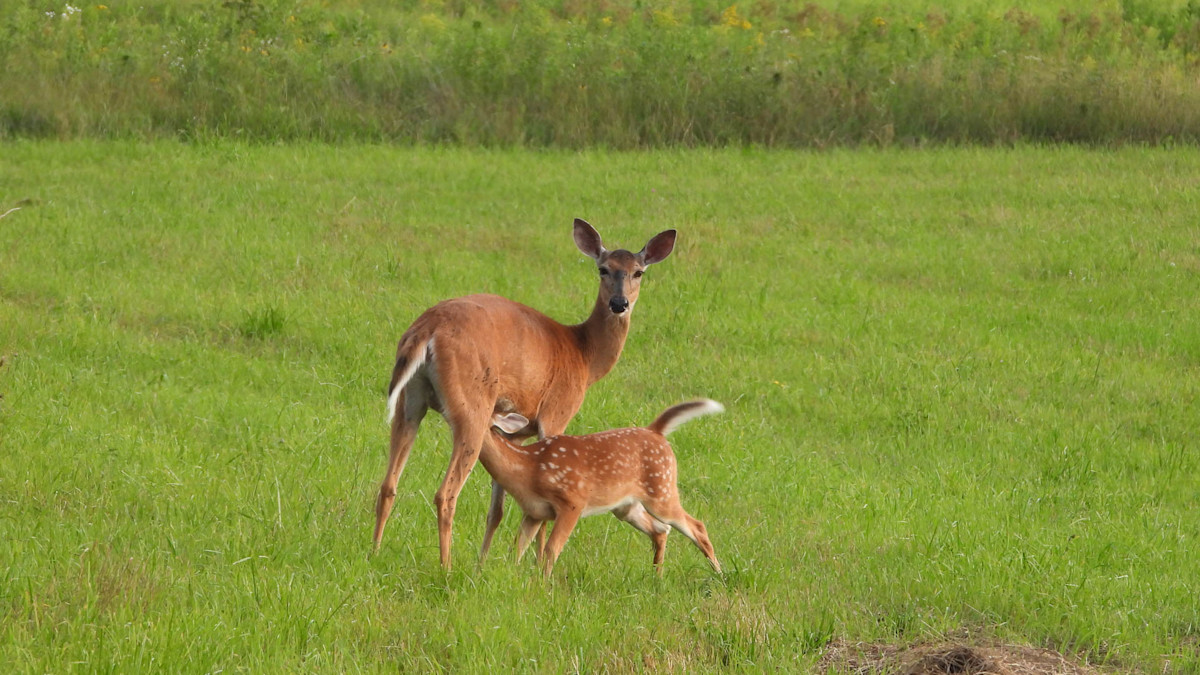

If there’s one disease that needs no introduction in the whitetail world, it’s CWD. Since its first detection in wild deer herds, chronic wasting disease has been a constant source of contention and uncertainty within the hunting community.
Studies have repeatedly shown that a high prevalence of chronic wasting disease can tip population growth rates into the negatives, since CWD is categorically fatal for any deer unlucky enough to contract it. Progression in infected individuals is wildly different from other high-profile diseases like EHD, which makes it particularly challenging to understand the long-term effects of CWD on whitetail populations.
While an EHD-positive deer is likely to be on death’s door within days, a CWD-positive deer might go years without experiencing any symptoms at all and take months to die after going clinical. The long incubation period makes it easy to point the finger at adult mortality as the sole driver of populations declines from CWD. But just because you’re unlikely to come across a fawn in the dazed and drooling state of an end-stage prion takeover, doesn’t mean fawns aren’t falling victim to the epidemic.
Doomed in the Womb
CWD does not seem to affect reproductive success of infected whitetails during the pre-clinical phase. A 2025 study in northern Illinois found that positive does were no less likely to get pregnant than negative does, which mirrored a 2012 study out of Wisconsin showing that both positive and negative bucks were equally likely to sire fawns. On the surface, those results seem to offer some hope for continued recruitment of youngsters into high-CWD populations despite the inevitable loss of infected adults.
Yet, the harder scientists look at the offspring of CWD does, the worse the implications get.
Until this year, the only correlation observed between maternal CWD infection and fetal development was a one-percent negative difference in fetal weight for CWD-positive does, which was not enough to suggest any impact on fawn survival. But the same Illinois researchers who found positive does just as likely to breed, recently discovered why their fawns might not be as likely to thrive.
It’s not some glaring deformity or systemic failure, but a subtle difference in fetal head development that could be dooming fawns of CWD moms well before they hit the ground. In the 2026 study, fetal skull length and circumference measurements were found to be significantly shorter in CWD-positive does. Although brains of those fetuses were not measured directly, a smaller skull generally indicates a smaller brain. And, according to the study, a smaller brain could mean a decline in cognitive development in fawns birthed by CWD positive does. Those cognitive skills, along with a healthy mother, are imperative for fawn success rates and make it even more challenging for those fawns to avoid predation. For deer in CWD-positive areas, those consequences could pose dire implications for local herds.
Even if the fawn of a positive doe were to overcome its potential cognitive disabilities, the odds that it avoids contracting its mom’s disease appear incredibly slim. Science still hasn’t produced an estimate on CWD transmission rates from doe to fawn, but it has shown that the prions can readily spread both in utero and through direct contact after birth.
Research also suggests that whitetail survival rates tank the hardest from CWD in the 1.5- and 2.5-year-old age classes. This research implies a lot about when and how many deer are contracting CWD, considering the typical incubation period of 18 to 24 months, and flies in the face of the long-held belief that CWD only affects older animals.
Bad Mom Theory
Seasoned hunters know that it’s often not the biggest bucks that prove to be the most cagey, but the old does, tasked with rearing the next generation. It’s a hard job, and might be made more difficult by the symptoms of CWD. More research out of Wisconsin in 2012 found that buck fawns with infected does were harvested about a month earlier on average and significantly farther away from their moms.
This is where these waters get murky. A buck fawn that disperses early due to inadequate maternal care and gets shot by a bowhunter or taken down by coyotes is unlikely to be counted as a CWD loss in anyone’s book, similar to a doe producing fewer viable offspring due to infection. Yet, both scenarios are very real ways in which CWD could have population-level impacts outside of direct death from infection. The latter is light on research in the whitetail world, but a 2013 study on Reeve’s muntjac deer in the UK suggests that stillbirth, as well as failure-to-thrive instances where mortality occurs within a few days after birth, could be higher for fawns of CWD-positive mothers.
The Big Picture
It’s still hard to say exactly what CWD means for deer and deer hunters as it continues to spread. Every year, researchers and game agencies provide more pieces of the puzzle, none of which paint a rosy picture of the future of America’s favorite game animal. Plenty of folks have written CWD off as just another thing that weeds the old and weak from the herd, but new findings indicate it is much more than that. And if we don’t take those warnings seriously, it’s entirely possible that, eventually, no one with a stake in the cervid game will have the option to ignore this disease.
Stay in the loop with The Wired to Hunt Newsletter
Shop
Related

Manage
Is CWD A Silent Fawn Killer?

Manage
Will CWD Cripple Wisconsin’s Booner-Buck Status?