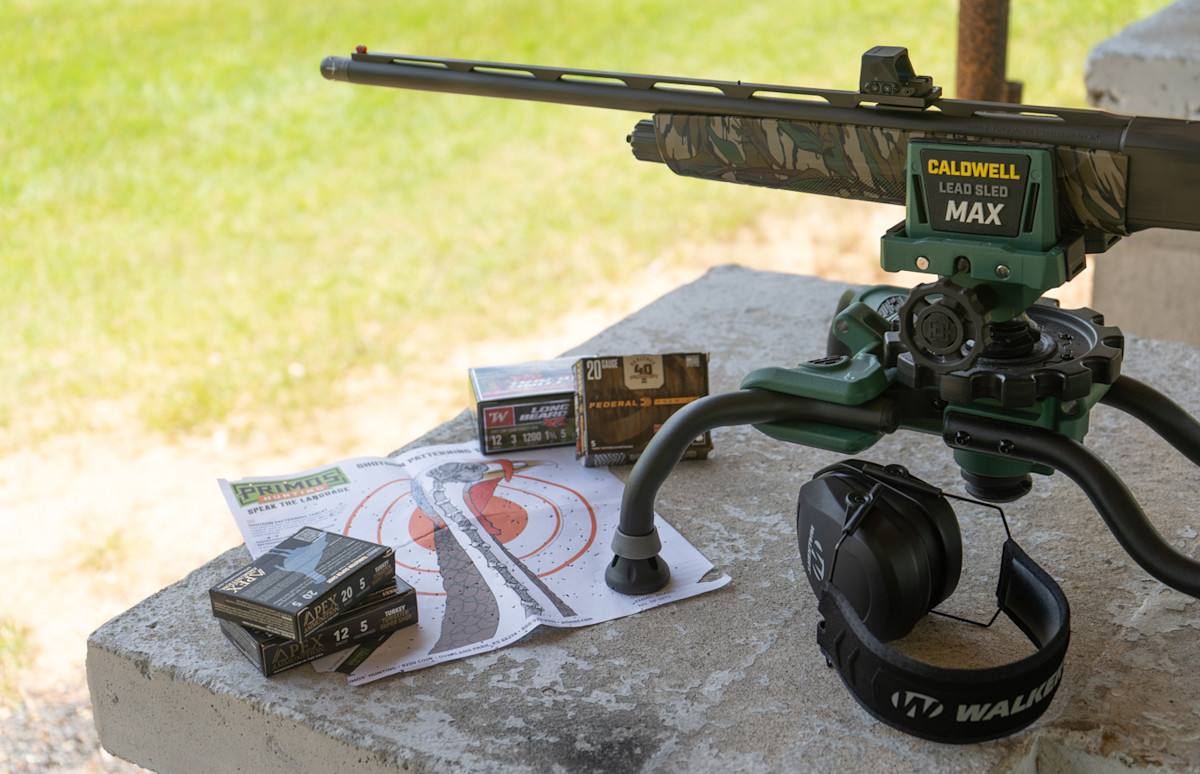

You learn a lot about turkey loads and shotguns after you send several dozen patterns down range in the name of research. For starters, I think I’ll stick to a 20 gauge next spring after putting my shoulder through the wringer. The devastating patterns from some of the 20-gauge loads also made that an easy decision.
A few of these points might seem like no-brainers, but they still warrant explanation based on the findings. Regardless, all of these points should come as good news for hunters considering upgrades to their existing turkey guns. Here are a few things I learned from testing the best turkey hunting shotguns.
Any Shotgun Can Be a Turkey Gun
You don’t have to buy an expensive turkey gun to kill a turkey. The Remington 870 proves that. While turkey-specific shotguns are cool, it’s easy to forget that hunters killed turkeys long before there were fancy shotguns with pistol grips, camo patterns, and extra full turkey chokes. Most turkey hunters used their shotguns for everything from squirrels and deer in the fall to turkeys in the spring.
Now, most basic shotguns come threaded for interchangeable chokes. This means you can find a turkey choke and load that works best for your gun and find its maximum range. If you’re on a budget and looking for a turkey hunting shotgun, start with the Remington 870. New, used, doesn’t matter. Which leads me to my next point.

The Remington 870 is the Best Turkey Gun Ever Made
Even beyond this test, I’ve patterned and reviewed this gun alongside other (more expensive) turkey guns, and the 870 produces some of the best patterning results for turkey hunting. It produced 407 pellet strikes in a 10-inch circle at 40 yards—the best pattern of the test—with a $30 Primos Tight Wad choke tube. Even with lead shot, the 870 averaged 216 pellet strikes at that same distance. Those are fantastic numbers from a shotgun that you can find anywhere, from $350 to $650.
I shoot an old Express model 870, but the new Fieldmaster versions are just as good if not slightly better, and I’ve never had a pump jam on me before. Its performance and affordability alone make it the best turkey gun ever made.
Finding the Right Choke and Load Combination Matters for Optimal Patterns
If you want to get the most from your turkey choke and ammo, you need to find the right combination. Think of your gun, load, and choke options as the reels on a slot machine. Hit the right three and you find the jackpot, but change any one of those, and you’ll have a different outcome.
Some of the best combinations I’ve tested placed 300-400 pellets within a 10-inch circle at 40 yards (with Apex TSS). But let’s not overcomplicate this. If you’re talking 40 yards or less, you can kill a turkey with at least 100 pellets in a 10-inch circle, and, no, it doesn’t have to be TSS.
But if you plan on running TSS, which has skyrocketed to more than $20 per shell for some 12 gauge options, you want to get the most out of your investment. Some guns and ammo will produce excellent patterns with one turkey choke, while another gun might show inconsistent patterns with that same combo. Luckily, brands like Carlson’s have eliminated the guesswork by making gun and load-specific chokes, so you don’t have to spend a fortune figuring out which one is best for your gun.
Winchester Long Beard XR is a Fantastic Lead Option
I’ve killed a ton of turkeys with Winchester’s Long Beard XR, so I didn’t need a turkey gun test to tell me that it’s a great option. Still, it was impressive to see how this ammo patterned in my recent turkey gun test and in previous work I’ve done in the past.
At forty yards, both the Remington 870 and the Mossberg 940 Pro averaged over 200 pellets in a 10-inch circle with 3-inch no. 6 loads. Meanwhile, all the 20 gauges in the test averaged over 100 pellets with 3-inch no. 5 Long Beard XR in a Carlson’s Long Beard XR choke. Those numbers are more than enough to kill a turkey at 40 yards and plenty for hunters who make shots from 30 yards or less.

If You Shoot a Sub-Gauge, You Should Use TSS
There’s a valid argument about the drawback of TSS at close ranges (20 yards or less), especially paired with a turkey choke. Those patterns can be the size of a softball, which makes it easy to miss a turkey’s head, especially if he’s moving. One flinch or head bob and you might miss him all together. That risk is valid, but it’s one worth taking. If you’re worried about missing a turkey that close, then try to stop him before taking a shot. Yelp a few times and that turkey will likely stop and poke his head up. Just make sure you’re tracking his head with your bead or red dot so you can make a quick shot as soon as he stops.
The 20 gauges in this turkey test all showed a significant decline in total pellet count at 40 yards when you compare the copper-plated lead to TSS. Pellet counts doubled (if not more) for each shotgun with TSS. That might not be the case with a 12 gauge like the Remington 870 that produced over 200 pellet strikes at 40 yards with Winchester Long Beard XR, but that’s not the case for sub-gauges.
Yes, part of that discrepancy in total pellet count has to do with the shot size and total shot available in a shell, but it’s a factor worth considering if you’re going to take shots at 40 yards. Not to mention, the density and pellet count of TSS help if you hunt areas with thick vegetation. I hunt in some of the thickest, greenest parts of the deep South. Most of my shots involve some kind of brush. I feel much more confident shooting TSS within 30 yards if I know some of my pattern might take a hit.

Final Thoughts
We might be living in the golden age of turkey guns, but that doesn’t mean you need to upgrade your current rig. Whether you roll with your grandfather’s old shotgun or decide to drop some cash on an ultra-specific turkey gun, there have never been more ways to punch your turkey tag.
Stay in the loop with The MeatEater Newsletter
Shop
Related
Firearms
The Best Turkey Hunting Shotguns
Gun Reviews
Beretta A300 Ultima Turkey Review: The Best 20 Gauge Turkey Gun

