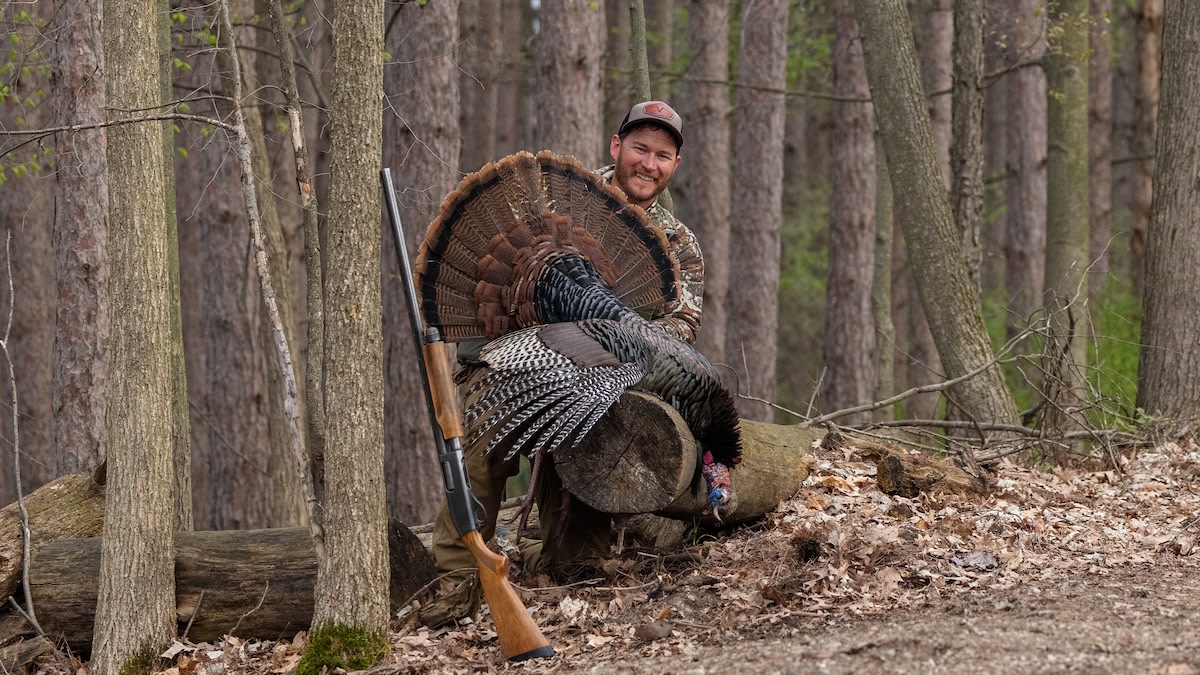

Lightweight, specialized shotguns with pistol grips, shorter barrels, constricted chokes, and red dots have taken over turkey hunting. Paired with heavy payloads of tungsten super shot (TSS)—and properly patterned—these guns can be deadly, especially at a distance.
However, there are a few narratives surrounding turkey guns that give hunters a false sense of confidence when a tom struts into shooting range. Don’t get me wrong, turkey guns can help you anchor a gobbler, but there are always trade-offs in the shotgun game, no matter the platform and load you select. What’s most important is that you pick a shotgun, shotshell, and choke combination that produces a pattern that makes allowances for shooter error but can also deliver sufficient energy at the target to punch your tag.
Red Dots vs. Shotgun Beads
I’ve patterned countless turkey shotguns and killed spring toms with and without red dot sights. Most hunters believe that an optic makes their shotgun more accurate, which is not really the case. A red dot can simplify the process of shooting a turkey. Sighted in properly, all you need to do is put the dot on the turkey's head or wattles and pull the trigger.
But an optic doesn’t magically put more pellets inside the 10-inch circle most turkey hunters use as a measurement to ensure their shotgun is capable of killing a tom. The point of impact will be similar whether you’re looking through a reflex sight or the bead at the end of your barrel. Of course, pellet count within the 10-inch circle will vary a bit, as no shotshell patterns are the same twice.
When I test turkey guns, I pattern the gun on paper without a red dot at 40 yards. Then I affix an optic to the top of the receiver, sight it in, and pattern the gun again at 40 yards. The patterns don’t change much when I shoot open sights versus a red dot. If I were shooting a single projectile, yes, the optic would be beneficial, even necessary. But I’m sending hundreds of round pellets downrange, all of which are susceptible to a myriad of factors. Simply put, red dots can make it easier to aim at your target, but do not improve shotgun patterns.
Red dots can also make you think that killing a turkey at long range is possible. But if you’re not experienced shooting turkeys beyond 40 yards or haven’t spent the time at the pattern board to see how the payload performs at distance, it’s a recipe for missing the shot. Or worse, wounding a tom.
I have a hunting buddy who has killed several long-distance turkeys. He knows exactly where to hold the red dot at multiple yardages to ensure a clean kill, and he hunts several states each spring, so he has more experience than your average hunter. A few years ago, I went out west with him to hunt Merriams. After roosting some birds the night before, a tom flew down a few hundred yards away from our setup the next morning. As soon as the tom hit the ground, I was looking through my red dot. It took the bird several minutes to meander toward us, and I ended up pulling the trigger too soon. The shot crippled the bird, and a second salvo was needed to dispatch it. Luckily, we were leaning against a tree in a wide-open pasture. Had we been in the woods, I might have lost that turkey.
My long-range turkey-shooting buddy asked me why I didn’t let the bird come closer. I told him I thought it was inside 40 yards, but it was more like 65 yards. Due to the low light and the fact that I had been on the gun for so long, it seemed the bird was well within range. I had extensively patterned my gun with the red dot and seen great results.
Unknowingly, that made me overconfident. I was too reliant on the optic and didn’t consider the bird might be farther than I thought. That is less likely to happen when shooting open sights, because you are relying on woodsmanship rather than technology.
Pattern Mythology
The head of a turkey is a small target, and many hunters (myself included) bought into the concept that you need to place as many pellets as possible inside a 10-inch circle to punch your tag. But that doesn’t make sense unless you’re intending to shoot a turkey at distance and need the pattern to stay together longer so it delivers enough energy to dispatch the bird at impact.
This may soon become a moot point, as TSS has become so expensive that some shotshell manufacturers have paused loading it, but too often, I see hunters laud TSS for the tight patterns it can produce. Yes, it’s incredible to see what TSS does on the pattern board and in the field; however, you don’t need (or even want) 350 No. 9s inside a 10-inch circle. Why? Because, as “cool” as that is to see on paper, it doesn’t allow for much shooter error, which is the No. 1 factor when missing anything with a shotgun.
If you're a seasoned turkey hunter who has killed 100 toms, disregard this. But for the rest of us, a wider, more pellet-rich pattern is the best recipe for success. How many times have you heard of a fellow turkey hunter missing a bird at close range? Or, how many times have you missed a tom that was almost in your lap? It’s likely because your pattern was the size of a softball.
To allow for increased shooter error, I have switched to a more open choke on my Remington 870. Previously, I used an aftermarket .665 constricted choke for the 12-gauge. On average, it placed 285 No. 9 TSS pellets inside the 10-inch circle at 40 yards. I decided to expand the circle to 20 inches for added forgiveness and insert an improved modified choke (.705 constriction). Shooting a 3-inch 1⅝-ounce shotshell (583 pellets) with a muzzle velocity of 1,200 fps, I have put as many as 500 pellets inside the 20-inch circle at 40 yards. By swapping chokes, I’ve turned a softball-sized pattern into a beach ball-sized one.
Sure, I have to pick a few more pellets from the breast meat of my turkeys, but I am also giving myself a better chance to kill a tom inside 40 yards.
The Recoil Factor
Turkey shotguns are typically lighter than the average field gun, making them ideal to carry through the woods. However, turkey-specific shotshells have heavy payloads, which is not ideal for accuracy when paired with a lightweight auto-loader or pump. Tighter turkey chokes also result in more felt recoil. When you constrict projectiles as they move towards the muzzle of a shotgun, it increases pressure and speeds up the shot.
Recoil can cause us to flinch in anticipation of the “kick” we feel in our shoulder when the trigger is pulled, the firing pin strikes the primer, and ignites the accelerant, causing a mini-explosion that pushes the payload forward and the shotgun rearward. Muzzle jump may increase with added recoil as well, causing your impact point to elevate and sail over the bird. Neither is good for shooting a small target like a gobbler’s head.
Specialized shotguns, tight chokes, and heavy payloads have a place in the turkey woods, but they are not a necessity. Before you invest, consider all the intangibles that come with such a platform and whether or not it makes sense for how you hunt. If it does, that’s great; you’re on the way to putting another gun in the closet. However, it’s just as likely that you already own a shotgun capable of killing a turkey.
Stay in the loop with The MeatEater Newsletter
Shop
Related
Firearms
You Don’t Need a Turkey Shotgun to Kill a Spring Tom
Turkey
You're Using the Wrong Choke with Your TSS Turkey Loads