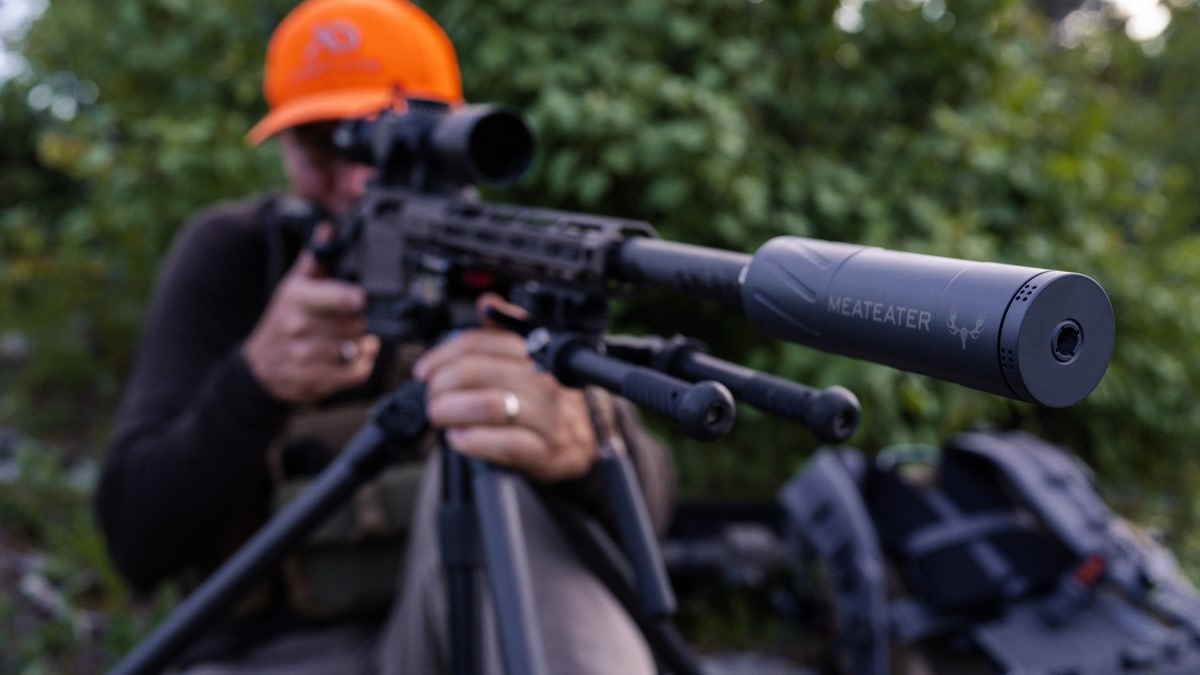

Once the territory of only the most dedicated gun nuts, suppressor use in the United States is on the rise among casual shooters and hunters alike.
If you’ve considered jumping into the wonderful world of quiet shooting, you’ve come to the right place. Here’s why you should use a suppressor, what kind of suppressor to look for, how to purchase a suppressor, and why now is the time to get on the bandwagon.
Why Hunters Should Use Suppressors
Ever notice that the old-timers with the best hunting stories can’t hear you reply? There’s a reason for that. The report from a rifle round creates tremendous pressure, which damages the tiny hair cells that are responsible for our hearing.
“Exposure to noise greater than 140 decibels can permanently damage hearing. Almost all firearms create noise that is over the 140-dB level,” according to the American Speech-Language-Hearing Association. “A small .22-caliber rifle can produce noise around 140 dB, while big-bore rifles and pistols can produce sound over 175 dB.”
Hunters are especially at risk since most don’t wear hearing protection in the field. But hunting with a suppressor can bring many calibers down to the 140-decibel range while also helping maintain situational awareness. And then there’s the obvious benefit of spooking less game when there’s a two-for-one or follow-up shot scenario.
The word “silencer” is a misnomer, because these devices certainly do not render a high-caliber rifle “silent.” They do, however, reduce the noise to safer levels. Suppressors are ubiquitous and even required for hunting in many countries across Europe and elsewhere because of their benefits for hunters’ ears.
Would you rather buy a suppressor now or hearing aids later? A suppressor is a lot more fun—trust me.
What to Look for in a Suppressor
Choosing a suppressor, like choosing a firearm, requires a clear sense of what you’ll be using it for. Even in the hunting world, different suppressors can fill different roles, just like different guns have different functions. A backcountry hunter might need a suppressor that weighs as little as possible while someone hunting from a box blind a half-mile from the road can afford to carry a little extra weight. A dad hoping to create a pleasant hunting experience for his daughter might care about sound suppression above all else while a competitive shooter might want a suppressor with a brake to reduce recoil.
Here are a few additional principles to keep in mind:
- Different suppressors are designed for different calibers. Be sure to purchase a suppressor that can handle whatever caliber you plan to use it with.
- Wider and longer suppressors tend to suppress sound more effectively than shorter and thinner suppressors, but the former cost more than the latter. This stuff might seem obvious, but we assume if you’re reading this that you’re somewhat green to suppressors.
- In terms of materials, the lightest suppressors are made of titanium, but they’re also the most expensive and can’t withstand high rates of fire. The most durable suppressors are constructed with steel or an alloy, but they’re heavier than titanium. Aluminum suppressors are often the least durable, but they’re lightweight and relatively inexpensive.
For the hunter who only plans to use a suppressor to pursue deer or elk a few times a year, aluminum might be a nice option. But for the hog hunter looking to eradicate a nuisance herd, steel, stellite, or titanium is best.
Users can go with either a direct thread attachment system (screw the suppressor right onto the barrel) or a quick-detach system (screw a muzzle device onto the barrel and attach the suppressor to the muzzle device). Direct-thread systems are best for bolt-action guns. They also don’t require the purchase of a separate muzzle device and they don’t produce as much point-of-impact shift.
Quick-detach systems allow users to quickly and easily swap suppressors from one gun to another. If you go with a quick-detach system, a non-locking taper mount system is often a good choice because these setups tend to align the suppressor more consistently than other quick-detach systems.
How to Purchase a Suppressor: the DIY Way
- Figure out whether your state allows suppressor ownership and/or hunting with a suppressor. Right now, eight states ban suppressor ownership and nine states ban hunting with a suppressor.

- If you live in a free state, pick out your suppressor, whether at a dealer or online.
- Fill out an ATF Form 4–either on paper or via ATF’s eForms website.
- Get fingerprints.
- Take a passport-style photo.
- Notify your Chief Law Enforcement Officer (CLEO).
- If filling out on paper, bring Form 4, photo, fingerprints, and check to a dealer.
The ATF reports that the Form 4 processing time for an individual filing via the eForms website is only 10 days on average. Paper submissions are 85 days, so it’s definitely worth it to figure out the eForms system.
Of course, “average” means your wait time might be longer or shorter. To make your wait time as short as possible, be sure there are no errors on your Form 4. If you have a common name, your Form 4 might be delayed as the ATF and FBI work out whether you’re the law-abiding John Smith… or the other one.
Your gun dealer will be able to help walk you through this process. And if they can’t, find a different dealer.
The Outfitter Way
You might not like the idea of an outfitter guiding you up to an elk so you can pull the trigger, but when it comes to buying a gun muffler, it’s way better to have someone else do all the work for you.
There are several companies that act like outfitters for filing your Form 4, but the one I used most recently is Silencer Central. Basically, Silencer Central takes the entire process out of the gun store and brings it home.
Once you select a suppressor from the Silencer Central website, you’ll receive a set of emailed instructions that walk you through the process. All the forms can be submitted online, and Silencer Central sends you instructions for taking a passport-style headshot with your phone.
They even send you an ink pad kit for filling out your own fingerprint cards. This was the most difficult step for me, and I will say I do prefer the electronic kiosks offered by other suppressor companies. But doing the cards at home was convenient, and I soon got the hang of it. And if you mess up, Silencer Central will send you another set of cards.
Once you send back your fingerprints, submit a photo, and provide all your personal information, Silencer Central submits your Form 4 to the ATF. If you have questions at any point, their customer service team is top-notch–friendly, responsive, and most importantly, actually helpful.
Speaking of helpful, Silencer Central also gives you the option of submitting as an individual or creating a trust. A trust allows you to add other people to the trust who can then legally possess that suppressor. You can also add new suppressors to the trust over time. Submitting as an individual sometimes comes with faster approval times, but in that case you’re the only person who can possess that suppressor. Silencer Central doesn’t charge you anything extra for creating a trust, so it’s a good option for anyone with family or friends to whom they’d like to loan or bequeath their suppressors.
Once you get the go-ahead from the ATF, Silencer Central ships your suppressor to your house.
Why Now is the Time
That means if you see a suppressor you've been wanting, and it's in stock, don't wait. Suppressor manufacturers aren't large outfits. If they run out of a specific model, it might take weeks or months to produce enough to resupply the dealers. Go ahead and start the process--once you take your first few shots with your new gun muffler, you'll never look back.
Stay in the loop with The MeatEater Newsletter
Shop
Related

Hunting Gear
The Total Guide to Buying a Used Gun

Firearms
Everything You Need to Know About Hunting with a Suppressor