Are Suppressors Now Legal to Buy Over the Counter? Sort Of. Here’s What You Need to Know.

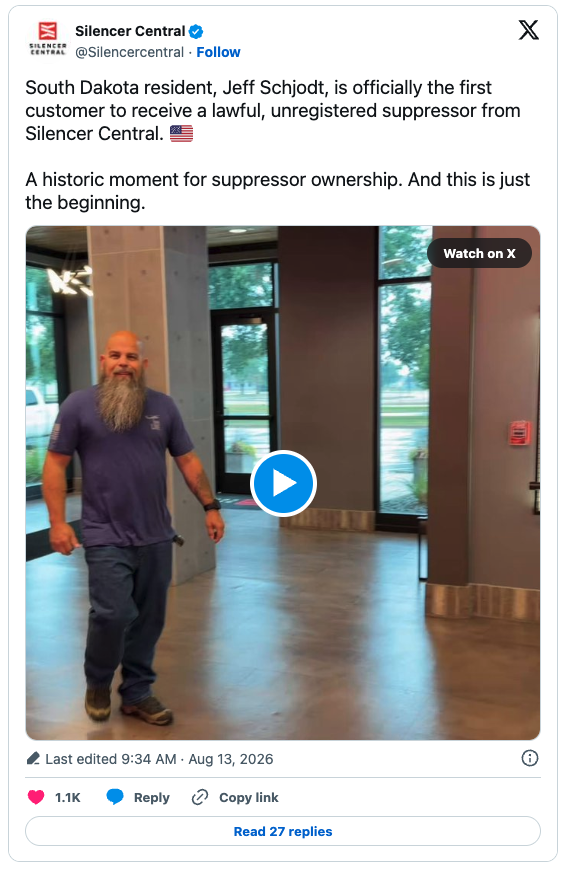
The nation’s two biggest suppressor dealers allowed customers to walk into their stores yesterday, purchase suppressors, and walk out with them. No fingerprints. No $200 tax. No wait time. They bought gun mufflers like they would firearms, passed instant background checks, and left.
And they didn’t do it in secret. They posted about it on X. Here’s Silencer Central announcing they sold a suppressor over the counter to a South Dakota resident who came into their shop.
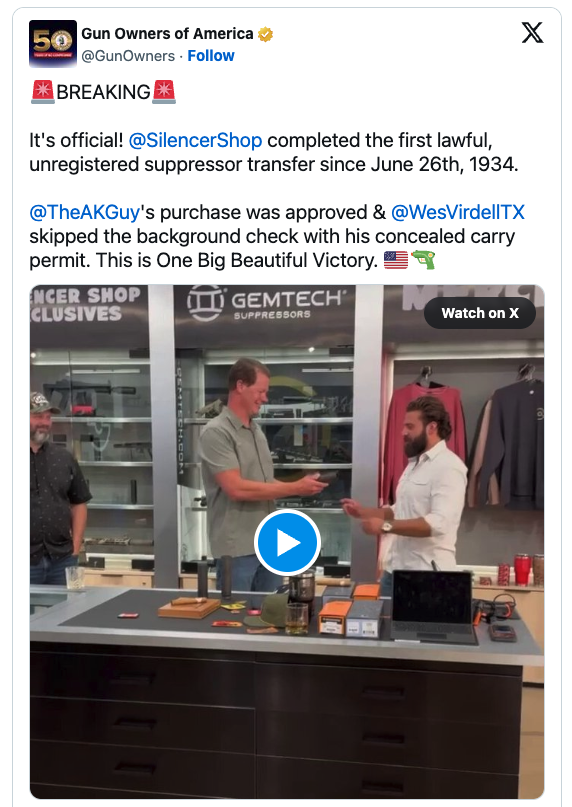
Same thing for Texas-based Silencer Shop, though instead of a regular Joe, their customers were guntuber-turned-politician Brandon Herrera and a Texas state representative named Wes Virdell.
The question millions of hunters and gun owners are asking themselves today is, can I do the same? Unfortunately, the answer may not be what you’re hoping for. It depends on who you are, where you live, and whether your local gun shop is willing to take a risk.
How’d We Get Here?
This story starts last summer when Congress included a provision in the One Big, Beautiful Bill that eliminated the $200 tax on suppressors. That was great news for eardrums everywhere, but as we reported at the time, gun rights groups saw it as the first step to total suppressor deregulation.
Those groups filed a lawsuit claiming that without the $200 tax, the National Firearms Act (NFA), the federal statute governing suppressor purchase and ownership, was null and void. In 1937, the Supreme Court ruled that the NFA was constitutional under Congress’s Article I power to tax. Without a tax on those items, the lawsuit argued, Congress has no authority to impose restrictions that verify the tax has been paid.
On August 5, a federal judge in Texas named James Hendrix issued a ruling agreeing with the plaintiffs.
“By zeroing out the transfer and making taxes for most NFA firearms, Congress eliminated the constitutional basis for the regulations that formerly supported the taxes for those firearms,” he wrote. “Thus, the challenged NFA provisions exceed Congress’s enumerated powers.”
A Shocking Development
Of course, we’ve seen this song and dance before. Lone federal judges have issued rulings striking down various gun control policies, but those rulings have never taken effect. That’s because, as the judge did in this case, they paused their rulings for a certain period of time to allow the Department of Justice to request a longer stay. The DOJ always did, and the cases were mired in the federal court system.
“Originally, I was told by the thought leaders in the industry that there was a 100% chance the DOJ was going to appeal this,” Silencer Central CEO Brandon Maddox told us.
But that’s not what happened this time.
Judge Hendrix gave the federal government a week to request to stay his ruling. But on August 12, hours before that deadline was set to expire, Rep. Andrew Clyde took to X to make an announcement few saw coming.
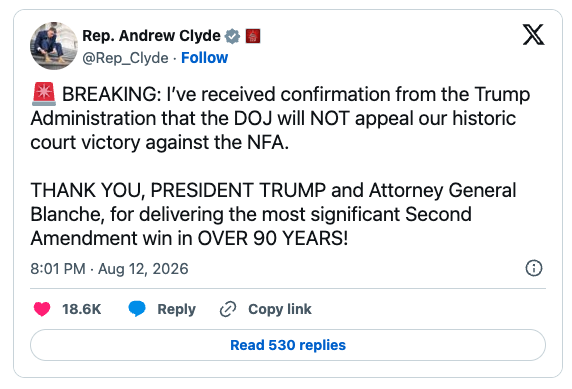
True to their word, the DOJ did not file a request to block the decision. Judge Hendrix’s ruling took effect at 12:01am on August 13 and removed suppressors from the NFA framework.
Ok, But What’s the Catch?
The problem is, there’s a catch–a pretty big one.
Judge Hendrix’s ruling does not impact state laws requiring suppressor purchase via the NFA system. Fifteen states have laws on the books that require residents to obtain federal approval before taking possession of a suppressor. If you live in one of those states, you can’t buy a gun muffler over the counter.
Here’s a helpful map. The red states are the ones that have state-level restrictions on the books.

Silencer Central has been sounding the alarm about this state-level issue. Last year, they worked in South Dakota and Kansas to repeal these laws, and they have legislation pending in Ohio. But similar bills have stalled in Mississippi and Georgia.
“It's something that we felt like no one was talking about,” he said. “Now, there's some people in the forums going, this really sucks for me. I'm in one of the fifteen states. So, it's not as wide-reaching as people think.”
What’s more, California, Hawaii, Illinois, New York, New Jersey, Massachusetts, Rhode Island, and Delaware ban suppressor ownership entirely. Judge Hendrix’s decision does not supersede these bans, so suppressors aren’t suddenly legal in these states, either.
So, Who Is Covered?
For the rest of us, Judge Hendrix’s decision does open the door to over-the-counter purchases. Whether you decide to walk through that door depends on a few factors.
First, it’s important to know that the ruling only covers the plaintiffs in this case—meaning, the individuals and groups who brought the challenge. That group of people is broad but does not cover all prospective suppressor purchasers.
- The plaintiffs include the following Second Amendment advocacy groups: Gun Owners of America, Gun Owners Foundation, the Silencer Shop Foundation, the Firearms Regulatory Accountability Coalition, the Texas State Rifle Association, the FPC Action Foundation, and the Citizens Committee For The Right To Keep And Bear Arms. The judge explicitly stated that not just employees or leaders but also members of these groups are covered under his ruling.
- Another group of plaintiffs covered by this ruling are the current and future customers of the businesses who were also named as plaintiffs. These include B&T USA, Palmetto State Armory, SilencerCo, Weapons Research, and Hot Shots Custom.
- Finally, the plaintiffs include 15 states, their agencies, and political subdivisions: Texas, Alaska, Georgia, Idaho, Indiana, Kansas, Louisiana, Montana, North Dakota, Oklahoma, South Carolina, South Dakota, Utah, West Virginia, and Wyoming. Importantly, this injunction does not extend to the residents of these states—just the states themselves and government entities.
If you’re not currently a member of one of these organizations, you can join one and purchase a suppressor over the counter. You could also purchase a suppressor from one of the companies that took part in the lawsuit. (Editor’s Note: This does not constitute legal advice. Jordan is not an attorney.)
What’s more, as Maddox explained, a gun shop can also join one of the covered organizations and sell suppressors over the counter—even if the purchaser is not covered under one of the plaintiff categories or the suppressor is not one of the listed manufacturers.
“The dealer has to join one of those associations—and some of them are as cheap as fifteen dollars—and it doesn't have to be a corporate membership or business membership. It just says you have to be a member,” Maddox explained. “Every attorney I’ve spoken with has agreed that if we join, we're covered. And then our customers downstream are covered as well.”
Whether gun shops avail themselves of this opportunity is another question. Here in Texas, I’ve seen several local gun shops post on Facebook that they’re waiting for official guidance from the ATF.
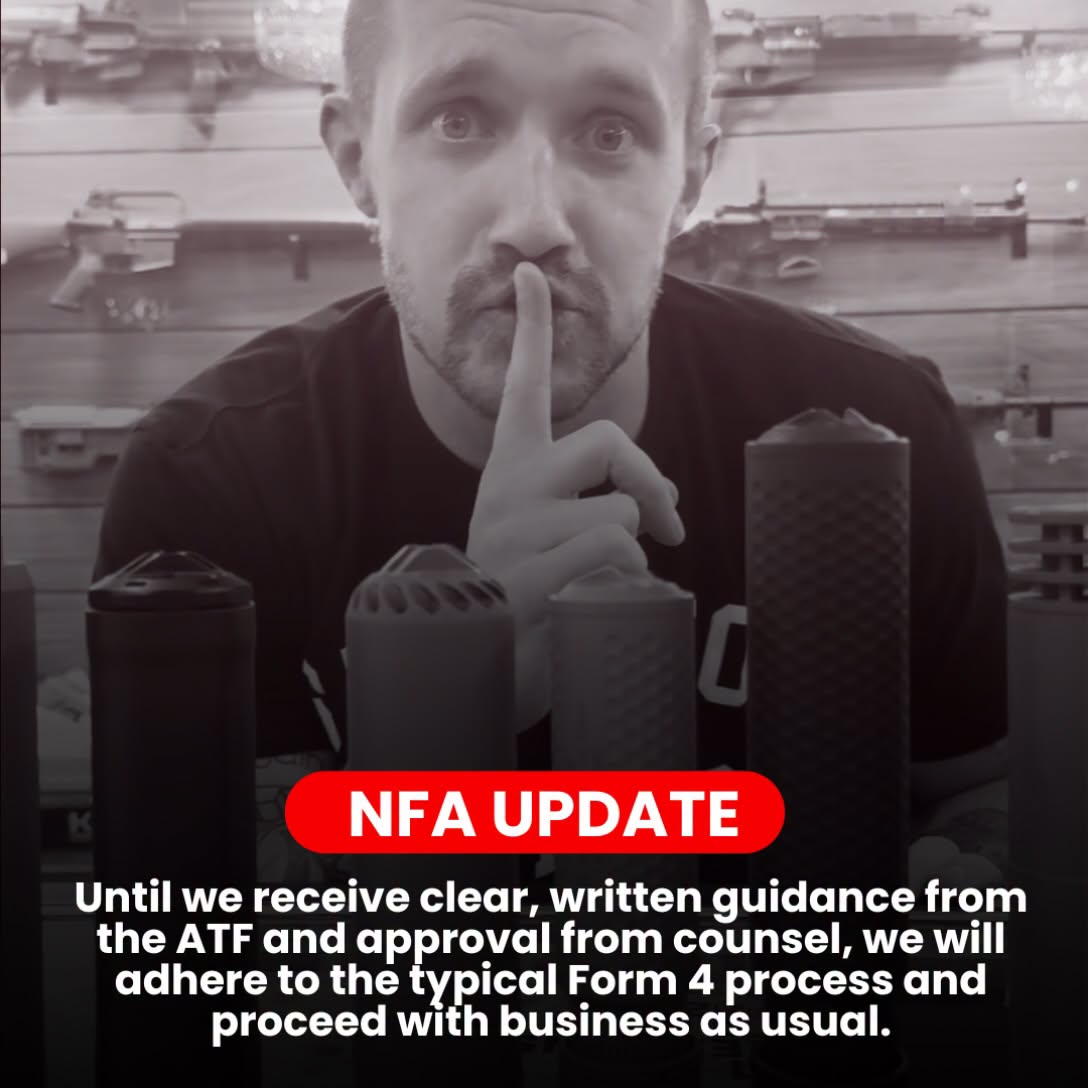
This post was made on August 13, so Mister Guns was aware of the DOJ’s decision not to appeal. But they still want legal cover before slinging suppressors over the counter—understandably so. Unlike Silencer Central, smaller gun shops don’t have teams of legal advisors, and if they mess up, the ATF can shut them down.
Silencer Central is confident in their legal analysis, so they and other big outfits are telling customers that they can come in and bring home a suppressor.
What’s Next?
The DOJ can still appeal this decision, so we won’t know whether these protections are locked in until that longer, 60-day appeal period has passed.
“If we believe Congressman Clyde, where he said that the Department of Justice is not going to appeal it, then we should assume the next sixty days they’re not going to. And maybe the ATF waits after that sixty days to see if the DOJ responds, and then after that gives guidance because then it would be kind of firm,” Maddox said.
How the next few months play out will also depend on what the states decide to do. Some states will remove their restrictions. But some might choose to move in the opposite direction. Looking at that map, I can spot a few gray states that might push back against the Trump administration by regulating suppressors—or even banning them—at the state level.
This will have a few implications for hunters. If you live in a state that requires going through the NFA process, you might be prohibited from buying new suppressors in the future if the NFA process ceases to exist. Maddox said that’s a real possibility.
“If you’re in one of the fifteen states and you’ve ever thought about getting a silencer, you may have a short window… If the DOJ lays down and your state’s not going to change their law, you’ll never be able to buy one. So, if you’ve been thinking about getting one, you better get in the process now,” he said.
What’s more, if you plan to travel to one of those states to hunt, you may not be allowed to bring your suppressor unless you have that NFA tax stamp. If I buy a suppressor over-the-counter in Texas but I hope to use it for my next mule deer hunt in Colorado, I won’t be able to under current law. For those who use a suppressor on out-of-state hunts, it might be worth going through the NFA process so you can bring along your gun muffler.
No one knows exactly how this is going to shake out. For now, do your research, find sources you trust, and keep an eye out for future updates. It’s an exciting time in the world of quiet shooting.
Stay in the loop with The MeatEater Newsletter
Shop
Related

Firearms
Everything You Need to Know About Hunting with a Suppressor
Firearms
Are Suppressors Now Legal to Buy Over the Counter? Sort Of. Here’s What You Need to Know.
Conversation