
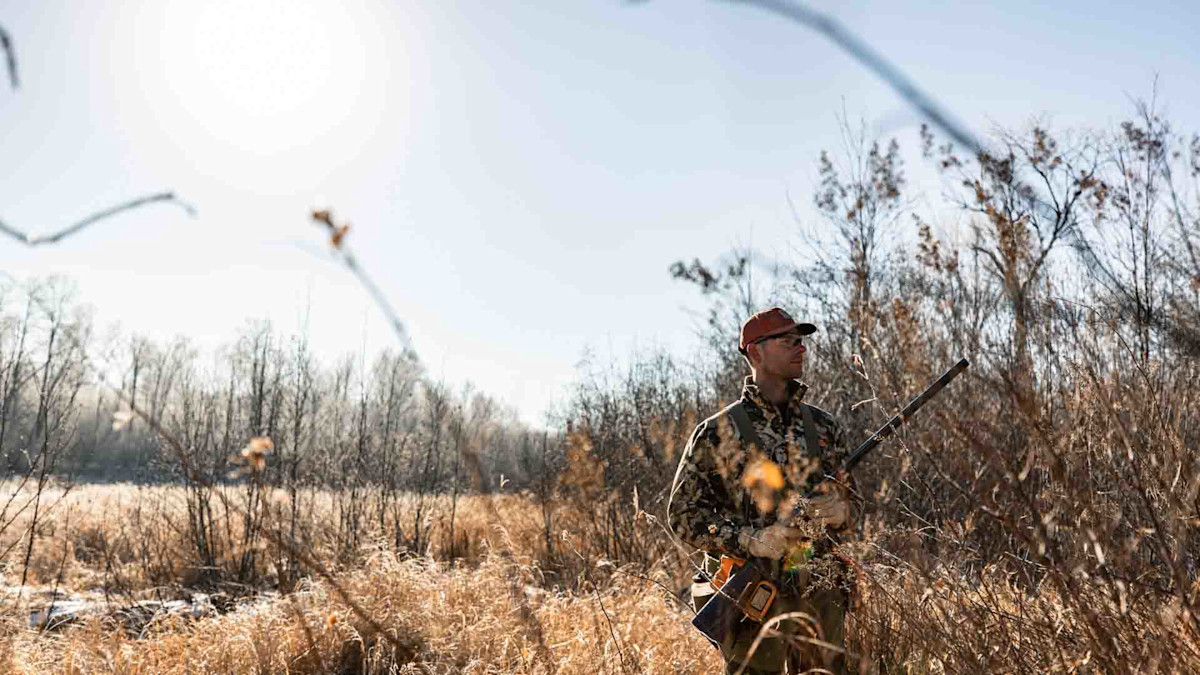

No matter how much you think you’ve mastered it, shooting a shotgun is a perishable skill. Like swinging a golf club or shooting a bow, you’re always better when you practice. The key with any kind of practice is to isolate your weaknesses and try to improve them.
Personally, I’ve found that getting regular shooting instruction a couple of times a year is the best way to stay sharp. But for all of those times in between lessons, you can still get out there and have meaningful practice at the range. Here are a few ways hunters can use clay shooting to get better at taking real-world shots they’ll see in the field.
Make Clay Shooting More Realistic
If you’re like me and you don’t travel to shoot birds in Europe, you’re probably never standing, gun at the ready, as a bird flies into view for you to shoot. In most hunting situations, you’re lying in the mud, breaking through branches, or caught wrong-footed with a ham sandwich in one hand and a GPS unit in the other.
That’s why you should practice like you play. Whether you’re hunting ducks or pheasants, try shooting clays from a low gun position. This forces you to work on your gun mount and incorporate it into shots. I find a sporting clay course is the best place for this if you hunt a variety of birds.
Waterfowl hunters can up the realism further by starting in a seated or lying down position. If your club allows it, bring your blind chair to shoot clays, or shoot from a layout position by making a simple backboard (basically a cornhole board you can lean against while lying on the ground). Safety should be your first priority, though, and you should check with wherever you’re shooting if it’s allowed to shoot from a lying down or seated position.
Find Ways to Hunt During the Offseason
The best wingshooters I know have a lot of practice on real birds as well as clays. One duck guide I’ve spoken with said that doves get him ready for teal and teal get him ready for big ducks. There are offseason hunting opportunities to sharpen your skills on birds that will even help fill the freezer. The first is feral pigeons. Pigeons decoy like mallards and taste a bit like a dove. They’re a pest on dairy farms and grain fields, and you can generally get permission from farmers to shoot them year-round with no limit. Try making or buying yourself a set of pigeon decoy silhouettes, and use the same layout or panel blind you would to hunt geese.
Upland hunters can get a bit of practice by participating in field trials for dogs. Field trials for organizations like NAVDHA are held with live planted birds like chukars. They need shooters to walk with the dogs and shoot the birds when they flush, which can give you a bit of practice and some groceries for later. Offseason hunts also allow you to test out shooting with new gear you might not be familiar with. If you’re changing things like your bird vest or hearing protection, give it a try on a pigeon hunt or field trial first.
Scale Things Down
One of the quickest ways to make shooting clays more challenging is to change your gun. Instead of toting a 12- or 20-gauge, drop down to a .410. The .410 can expose a bad flinch, and it will make the easy shots hard. With less shot in the air, you’ll need to do everything right to hit a clay. When you switch back to your 12 gauge, it’ll feel like you can’t miss.
Close Your Eyes
Sometimes you need to make a shot quickly, especially in thick cover like grouse woods. Most American shooters are good at instinctive shots because we “walk up” our birds rather than standing in one place and having them driven to us. Still, the quickest way to screw up an instinctive shot is to get in your head and aim.
Once you’re in your head, it’s very hard to get out of it. One trick I’ve found is to close your eyes. Make sure you're in a safe environment, ideally at a stand, gun mounted, safety on, finger off the trigger. Also, using a type of hearing protection, like electronic ear plugs, where you can hear others is nice to have should someone need to communicate with you. With your eyes closed, call pull, then open them and shoot the clay. This will force you to react quickly to the clay after it’s in the air and hopefully cure you of overthinking.
Master the Crossing Shot
A fast-moving crosser is one of the more difficult shots to hit, especially for a waterfowler. It has always dogged me because I’m naturally more of an instinctive shooter, and it took me a long time to learn when to use a repeatable process like swing through or sustained lead. Still, the better you can get at crossing shots the better off you’ll be when you’re shooting at the real thing.
If you struggle with crossers, station training is the best way to get better. Essentially, you start your clay thrower slightly quartering away from you and slowly increase the angle once you master a given angle. At the end, you should be shooting a clay flying 90 degrees in front of you at about 20 yards. Increase the distance to 30 and 40 yards once you master that shot.
Try Some Other Shooting Games
Everybody knows about trap, skeet, and sporting clays, and those are all good games to get sharp for the season. But there are some more informal games to mix it up a bit. The first is Annie Oakley. To play, two shooters stand side by side, while a third person throws a clay—ideally something that will loaf in the air for a bit. The first shooter takes a shot and ideally breaks the clay. Once that happens, both shooters try to hit the broken pieces before they hit the ground. You’re awarded points for the first clay and every piece you can hit after.
Another good game is Knock Out, but you need a small group. The shooters stand in a line with a trap set up to cross a clay in front of them. When the clay passes the first shooter, he takes a shot. If he hits the clay, he can stay in. If he misses and the next shooter hits it, the first shooter is eliminated. If the first and second shooters miss, but the third hits, then both of those shooters are eliminated. The last shooter standing wins. It helps to play both games with electronic ear protection, so you can hear commands and trash talk. And they’re both great ways to replicate the pressure and anticipation of hunting birds in a group.
Stay in the loop with The MeatEater Newsletter
Shop
Related
Firearms
6 Shotgun Drills to Practice for Wingshooting
Firearms
5 Shotgun Drills To Get Ready for Fall

Conversation