
I sat in the truck at the public boat ramp, sipping bad gas station coffee and watching a parade of glitter-covered bass boats launch and race away. They were in a hurry to get to wherever they thought the bass were holed up.
I wasn’t in much of a hurry. When the last boat disappeared around the point, I grabbed my spinning rod and a Rat-L-Trap and walked down the shoreline in my flip-flops. On the third cast, my line went tight as a largemouth bulldogged for deeper water, pulling line from a rig that probably cost me less than a tank of gas in the prettiest boat that launched that morning. A few minutes later, I lipped the fish and looked out across the water. There wasn’t a boat in sight.
Bass don’t know how much your boat payment is or if you even have one. If you can land a lure where they’re living, there’s a chance they’re going to bite it. And a surprising number of bass spend a good chunk of their lives within casting distance of the bank. Some of the best bass water on Earth sits right up against the shoreline. And that’s more than enough if you know how to fish it.
Fish the Bank Like a Hunter
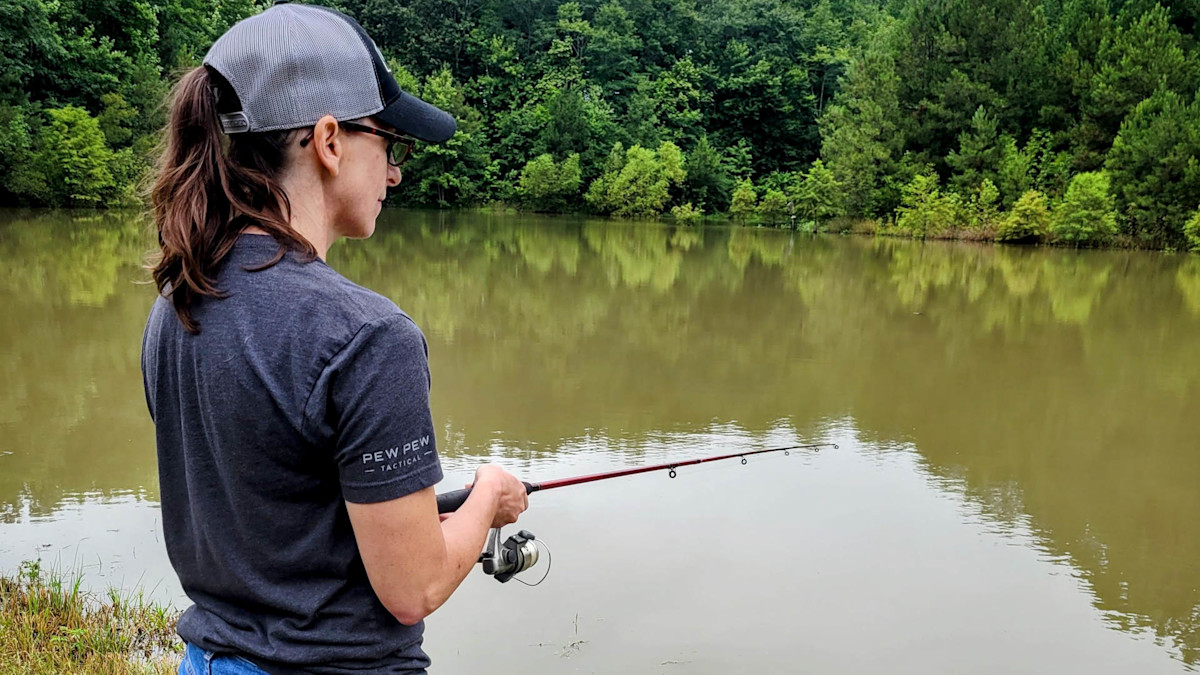
A lot of anglers treat bank fishing like they’re married to a single spot. You may not have a trolling motor to drift from point to point or ease along a grass line, but you still have two perfectly good feet. Don’t be afraid to use them. You should be moving more than you’re standing still.
Just don’t slosh and stomp around the shoreline. Bass are especially skittish in shallow water. A heavy step or a dark shape sweeping over a laydown can send them swimming.
Move like you’re still-hunting for deer. Fish can feel vibrations through the water, so step lightly and watch where you cast your shadow. Keep a low profile when you can, and when possible, make some casts before you’re right on top of the water.
Take the same approach from the bank as you would a boat. Find structures that give bass a reason to hang out. Shady docks, ledges that drop into deeper water, weed beds, culverts, and laydowns that break current will all hold bass. Most of that structure can be reached from the bank.
The best water isn’t always the most convenient. Don’t skip the spot closest to the parking lot, but don’t stop there. Keep moving down the shoreline until you find fish.
The Bank Holds Plenty of Bass
Bass boats spend a lot of time working shoreline water. That’s because there are plenty of bass there. Food, cover, and movement all funnel toward the edges. The groceries live in shallow water. Bluegill, shad fry, crawfish, and frogs all hang out there. And bass like to sit right in the buffet line. They don’t need to travel far when dinner is liable to swim right past their nose.
Cover seals the deal. Docks, weeds, laydowns, and drop-offs give bass a place to hide and pin prey. And most cover lies within casting distance of the bank.
Fishing from the bank may even have a few advantages over boat fishing. Boat anglers sometimes spend a lot of time zipping from spot to spot chasing the bite. Meanwhile, the guy on shore is busy fishing. He’s also approaching the same cover, but from angles high-pressure bass see less often.
Bank Fishing Lures
Bank anglers can’t feasibly carry seventeen rods all strung up with different baits, so every lure you carry needs to earn its weight. I tend to think of my bank-fishing lures in terms of what jobs they do well. I want something that helps me cover water fast, something that can get the attention of fish from a distance, and something that can clean up if the first two fail.
I like to cover water fast when I first walk up to the shoreline, and a spinnerbait or a lipless crankbait like a Rat-L-Trap helps me search water fast because I can make a lot of casts in a hurry. Those baits are also forgiving. They tend to shrug off grass, slide over overhead limbs, and slide past gnarly underwater junk better than anything with treble hooks. That matters more than you may think when you can’t really pick your casting angles. I throw them along points, creek mouths, grass beds, around pylons, or anywhere else that looks bassy.
I also love a good topwater bait. A buzzbait or jitterbug not only covers a lot of surface area, but they also make a ton of racket that can sometimes draw fish in from a distance. There’s nothing subtle about these baits. They’re loud. They’re obnoxious. Sometimes that’s exactly what a bass wants. There’s also something about seeing a fish explode through the surface to hammer a lure that gets the adrenaline pumping.
Finally, I like a Texas-rig worm for bank fishing. I don’t use it as a search bait. I use it more as a problem solver. If a spinnerbait or buzzbait comes back empty after covering some bassy water, I don’t keep grinding it out. But if I think it might be worth a little extra effort, I’ll tie on a Texas rig.
A Texas rig lets me slow down for just a minute. I can drag it across a log, pitch it into the darkest shade of a dock, or drop it into thick lily pads. If something is lurking down there, a slow-working worm could be just the thing you need to entice a bite. If that doesn’t work either, I move to a new stretch of shoreline.
How to Work the Bank
It might be tempting to stand on the bank and pitch a bait straight out into the water as far as you can cast. But the longest cast isn’t necessarily the best one. Bass aren’t just casually sitting 20 yards out from the bank waiting for a snack to pass overhead. They position themselves relative to something in the water, and the longer your bait stays near that cover, the better your chances of getting a bite.
Try to cast parallel to structure whenever possible so you can work your bait along the edge for longer. The same bait worked perpendicular to the same structure may only spend a few feet in the strike zone. But if it swims parallel, it will spend most of the retrieve swimming right where bass like to be.
Final Thoughts
A bass boat can open up a whole lot of water. And I definitely won’t argue if somebody wants to hand me the keys to a hot new set-up. But bass don’t care whether you arrived at the lake in an expensive glitter-covered boat or a cheap pair of flip-flops. They care about food and cover. And fortunately, there’s plenty of both within casting distance of the bank.
Stay in the loop with The MeatEater Newsletter
Related
Fishing
Bank Fishing for Bass Isn't a Backup Plan
Fishing
Best Techniques for Spring Bass