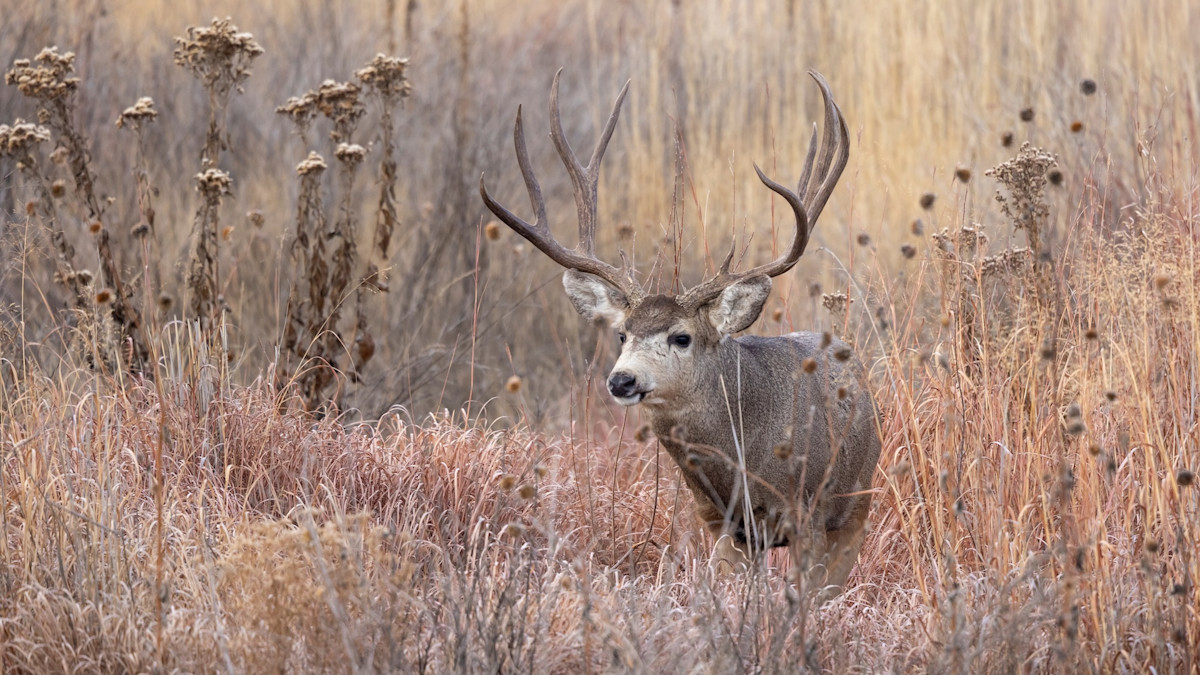

Western states have a mule deer problem. Deer populations are down across the board, leaving fish and game commissions grasping for means to mitigate the declines. Often, the only lever immediately within reach is a control on hunting pressure, which commissioners are reluctant to touch, as it obviously comes at the expense of hunting opportunity.
Last week, however, commissioners in Montana made the decision to reduce nonresident deer tags by about 2,500 for the next two years, with the goal of reducing both overall hunter numbers and crowding from out-of-state hunters. The commission also reduced the number of deer tags resident hunters can hold in a season from eight to three.
But will the cuts be enough to make any meaningful difference on deer populations? Or were they even necessary? Among hunters, the jury is split. MeatEater spoke with several hunters in the state who have made efforts to influence policy or have their voices heard.
Leading up to the regulation-setting meeting, Montana Fish, Wildlife & Parks solicited input from a Mule Deer Citizen Advisory Council, formed of 14 hunters from across the state. One member, Gwen Cooper, offered insight into the discussions held over the last two years.
“Everyone was on the same page that something needed to be done,” Cooper said. “But a huge argument between all of the board members was that some people thought limiting buck tags would improve the population overall and result in more healthy and larger deer, and then another side of the room was like, ‘that’s not true.’”
Another council member, Eric Albus (also a legislator, rancher, and outfitter in eastern Montana) was of the former opinion. “The pressure that we get here with an unregulated five-week-long rifle season—which encompasses the rut—the hunting pressure has totally destroyed the mule deer population in eastern Montana, along with any quality that might have been here,” Albus told MeatEater. “Some of the places that I hunt down in southeast Montana are all private, and we average 6.5 years of age on our mule deer. The oldest deer we killed last year was 9.5 years old. So it’s not rocket science to manage a deer herd. You just have to limit opportunity to harvest.”
However, that model of management might not hold true everywhere. Just ask Marcus Hockett, who is on the crew of Fresh Tracks. “I used to be amongst the crowd that thought we should have more special permits; that we should not be hunting mule deer bucks in the rut because we hammer them and there’s no more mature bucks,” Hockett said. “But I’ve since changed my mind, because I’ve hunted and filmed some of the most amazing mule deer hunts that you can go on—hunts that take a lifetime to draw—and some of them have been absolutely awful.”
On a recent ‘once-in-a-lifetime’ Kaibab deer hunt in Arizona, Hockett and the crew didn’t see a buck over three years old. But even after hunting all over the West, Hockett says the best deer hunting he’s ever had has been on a Montana general season deer tag. Still, he agrees, the quality of hunting has decreased overall in recent years.
Unfortunately, there’s no one-size-fits-all solution to the problem. Hunter observations are anecdotal, and commissioners are tasked with balancing a number of factors (quality, opportunity, CWD management, etc.) when setting regulations. Not to mention, Montana is a large, diverse state. “How do you manage Region 7 the same as you manage Region 2 or Region 4?” Cooper asked. “There’s such different territory. The terrain is so different, the lifestyle is different, the people are different, and it’s hard to have one plan that makes everyone happy, given all of those.”
However, there is one thing all three hunters—Cooper, Albus, and Hockett—agree on: the state needs even more limits on doe hunting. From a population standpoint, mule deer depend more on the number of does than the number of bucks. In Montana, the state aims to manage most units to have between 10 and 40 bucks per 100 does, but it can take decades for a change in hunting regulations to alter the buck-to-doe ratio in a hunting district, according to a 2018 study. That’s to say, reducing buck harvest is a better way to improve the age structure of a population (over a long time period), while reducing doe harvest can have more of a population-level impact.
Yet Montana commissioners are reluctant to limit doe harvest to the extent that most hunters would consider necessary. Cutting resident tags from eight to three will certainly help, but in large swaths of the state, a hunter can still shoot a doe with a general deer license. With the new regulation changes, about 12,000 nonresident general deer licenses will still be available, in addition to the nearly 135,000 resident tags sold every year.
Albus is frustrated by the lack of action. “We needed to cut these tags, and we need resident numbers cut as well. We need to end the harvest of any mule deer or whitetail doe in regions 6 or 7 for several years.” As an outfitter, Albus said it would cut into his bottom line, “but I’m a resource-first person. I believe we manage the resource first, and everything else will fall into place.”
Hockett has a broader view of the issue. “We spend so much time arguing about how many deer we’re killing, which is fine, but nobody wants to talk about the real issues, which are habitat, competition from elk, and human recreation. All that stuff adds up, and that’s what’s driving mule deer populations down, not hunting mule deer bucks in the rut. So we can talk about that, but to me it’s this giant distraction.”
Hockett acknowledges that his opinion is generally an unpopular one. But when it comes down to tangible actions, wildlife managers don’t have many options aside from controlling harvest, so that’s the lever they pull.
Still, the question remains: will it be enough to stave off a continued mule deer decline in Montana? It could take years to find out, but that’s just the nature of wildlife management.
Stay in the loop with The MeatEater Newsletter
Shop
Related
Wildlife Management
Can Cutting Tags Fix Montana’s Deer Problem?

Wildlife Management
Montana BHA is Raffling a Statewide Mule Deer Tag