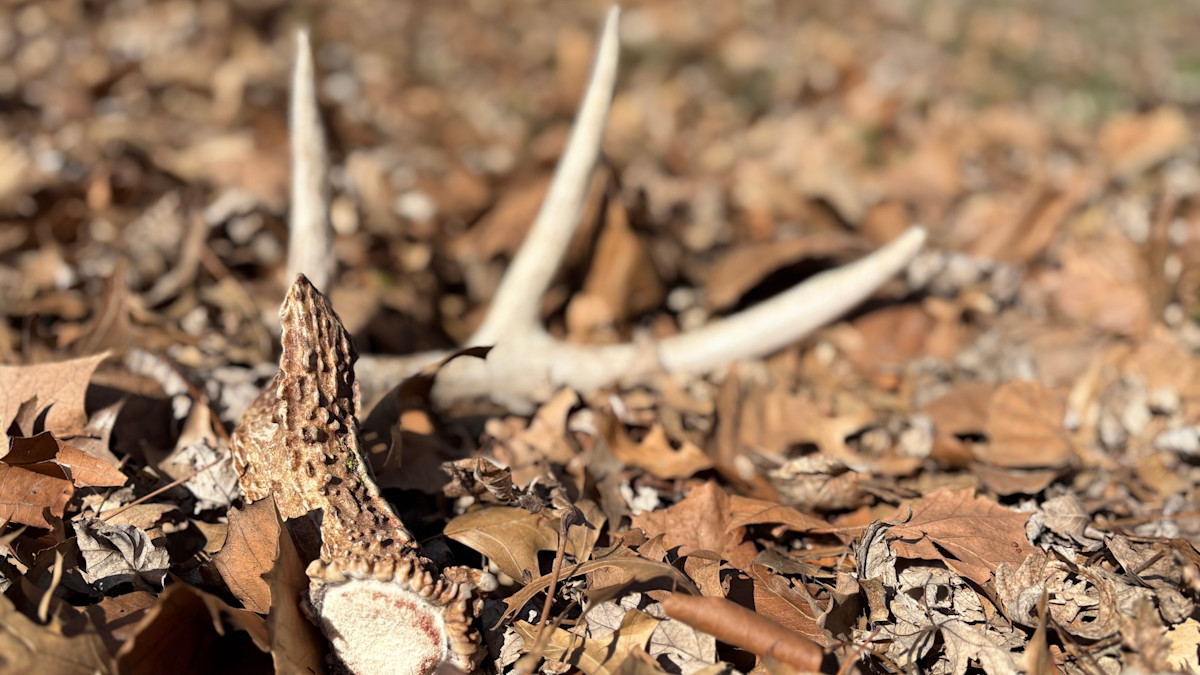

Anyone reading this could look at my daily step counts since early February and know exactly what I’ve been up to. For me, it’s partly a coping mechanism, and partly a thrill in itself to comb the whitetail woods in search of discarded headgear. Peak shed season falls perfectly between trapping season and turkey season, which gives my outdoor-obsessed brain something to cling to in the void. But shed hunting on public land is often a low-odds deal, no matter how hopeful I am when I walk out the door.
This is the reality for a lot of hunters, and it often forces you to think outside of the box if you want to find more antlers. If you’ve been struggling to find more bone, here are a few ways to make your shed hunting more productive on pressured ground.
The Path Less Traveled
Social media is plastered with dream shed hunting scenarios. Matched sets displayed on manicured lawns, mowed-down food plots, and generally unrealistic scenarios for the majority of workaday hunters. Whitetail candyland exists, but unless you’re willing to pay to play, you’ll have to focus your time on pressured ground.
Public land shed hunters, and even those with access to private land who share it with other rack junkies, need to understand this reality. Your success won’t mirror those on carefully curated ground with exclusive access, and neither will your efforts. Sure, I’ve found a handful of field sheds over the years. But if all you do is walk the ag, you’re destined for a net-negative experience. It’s not that bucks don’t drop in public fields, but the bulk of the competition is going to look there first. Unless you can get there as soon as that buck drops, you might go home empty-handed.
Instead of obvious spots, consider where pressured bucks like to hide and bust out your brush pants. All of my biggest sheds and sets have come from the gnarliest thickets and ridges where no one else wanted or thought to look.
I look at it this way: I know I have to cover a lot of ground, but only small, hard-to-walk pieces of that ground are likely to offer me any bone. It’s no different from trying to find a little concentration of deer during the fall hunting season after the pressure has been heavy for a month. They will spend a disproportionate amount of time in places people go the least.
When it comes to sheds, it’s easy to walk around those spots. If you shed hunt where the competition is fierce, you simply have to do what most people won’t. Even then, you’ll probably return with an empty pack.
Reframe the Mission
Maybe I’m an outlier, but sheds alone are sometimes not enough motivation for me to get pricked by a hundred thorns or aggravate my sciatica. Don’t get me wrong, the sight of a tine peeking through the leaves always excites me. But when my only goal is to find an antler, I can’t always keep my head in the game.
My favorite way to shed hunt is more like winter scouting. It might be ground-truthing a potential bedding area that I pinned in onX back in November, or searching for dormant feed trees in remote hardwoods, but I always have a scouting goal in mind before I start walking.
That deeper sense of purpose and curiosity pushes me through areas I might otherwise try to avoid and keeps me from falling into what I call “bored reader syndrome.” That is, when your eyes are moving across a page, but your brain is absorbing exactly none of the information.
Combining winter scouting with a shed mission gives me two goals for every expedition. That lessens the blow if I don’t turn up any antlers, and makes the effort always seem worth it. It also allows me to pick apart deer ground with a plan, which usually helps me find those little islands of activity that might actually have some overlooked antlers in them. This scouting mindset also makes me more attentive, which is the missing piece for so many dejected shed hunters.
Slow and Steady
I actually didn’t have sheds in mind at all when I found my first antler of this year. I was stalking cottontails in a mature hedgerow in mid-February when I nearly stepped on a 4-point beauty that looked to be at least a week or two old. There’s no doubt in my mind that the majority of field walkers would have passed within a few yards of that shed and never seen it. Considering that I was on public land close to town, it’s pretty likely that some did. But I scored the prize, because I was laser-focused and moving at a snail’s pace.
This is something I can’t stress enough. It’s easy to think more miles equal more antlers. There is a correlation, but it’s like fishing a small stream–it’s fun to see what’s around the next bend, but if you don’t fish the closest pool with intention, you’ll miss out on fish. Wanderlust is fun, but it can cost you some golden opportunities.
Don’t just burn through 15 miles a day, but try to think critically about where bucks were most likely to drop their headgear. This goes beyond basic bedding and food sources, and into understanding how they might use the terrain and vegetation to their advantage.
Remember, if you’re 10 yards off, you might as well be 1000 off in the right cover. A lot of bone can hide in the right half-acre, especially if most folks are just focused on getting to the next ridge.
Stay in the loop with The Wired to Hunt Newsletter
Shop
Related
Scout
How to Find More Matched Sets of Shed Antlers This Winter


Scout
Why Is Shed Hunting More Difficult Than It Should Be?