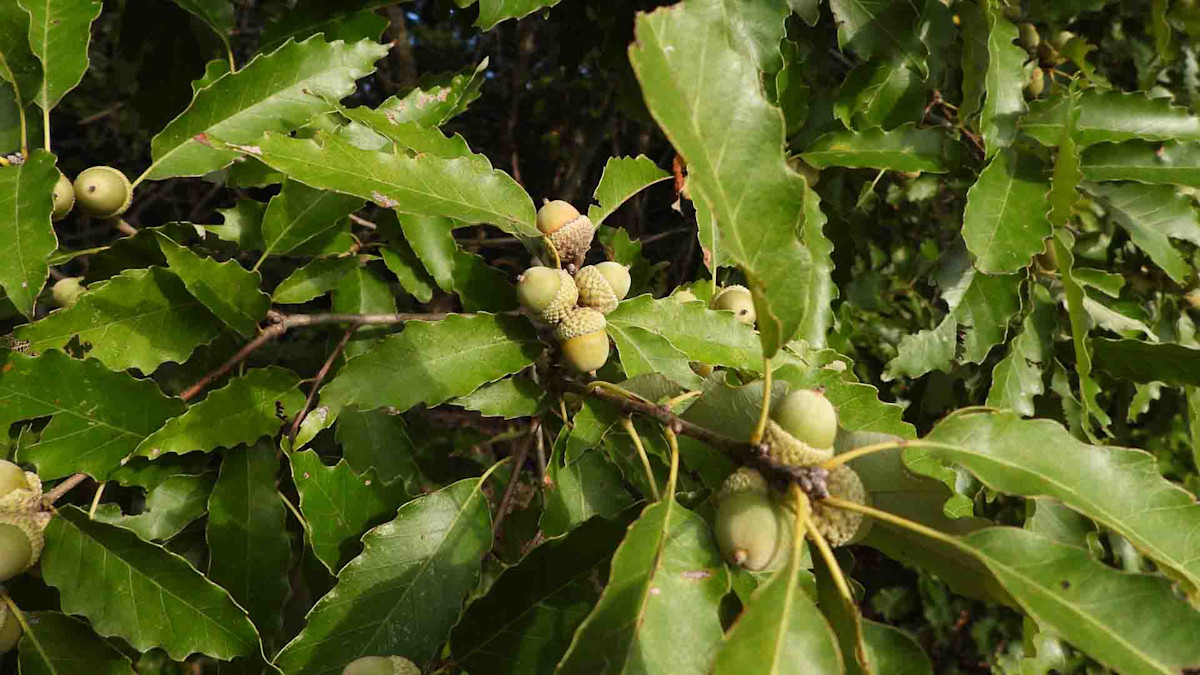

A few years ago, I spent my whole opening week in Kansas hunting a green soybean field full of browsing scars but didn’t see a single deer. When I finally stepped into the woods to find them, I found an area that looked like a feedlot—trampled to bare dirt with a healthy amount of whitetail poo sprinkled throughout.
I heard the reason for the scene before I spotted it as a few bur oak acorns tumbled to the ground. One massive tree was dropping hard and had seemingly pulled every whitetail in the county into its orbit. My months of summer scouting became obsolete in an instant, and I filled my buck tag under that tree two days later.
There are dozens of physiological and environmental factors that turn clockwork summer patterns into a pile of question marks by October, but acorns are arguably the most important for an early-season deer hunter to understand.
Perfect Timing
There’s a lot of protein propaganda in the whitetail world, and not without good reason. Protein is a necessary macronutrient for all living things, and it’s especially critical for summer whitetails in the midst of antler production, lactation, and regular body growth.
Crops such as soybeans and alfalfa are a hot commodity while protein needs are high, which create the pre-season trail camera and glassing opportunities that deer hunters drool over. However, once antlers harden and fawns are weaned, the looming energy demands of fall and winter push protein to the backseat. That happens to also be when acorns hit the ground.
Acorns can’t compete with most destination food sources for protein content, but they wipe the floor on the energy front. Nothing allows a whitetail to rapidly pack on fat like a hearty acorn crop, and they know it. A 1975 study in Virginia discovered that acorns accounted for over two-thirds of the diet volume of monitored deer in years of high abundance.
Another Virginia study found that deer expanded their home ranges to include acorn-rich areas and spent half of their foraging time on acorns alone during peak mast-fall, which conveniently straddles archery opener and pre-rut across much of North America. Acorns are a prime suspect when early-season deer suddenly vanish into the timber, but their influence varies by year and by species.
All In The Macros
Sadly, deer hunting is not as simple as finding acorns. Not all acorns are equal in the eyes of a whitetail. North American oaks are divided into two main subgroups: red and white. Acorns of the red oak subgroup are generally higher in protein and fat than white oak acorns while being comparably high in carbs, but they’re also significantly higher in tannins and fiber. That makes them both less palatable and less digestible for deer despite appearing to have a better nutritional profile.
White oak acorns also germinate almost immediately after falling, which spurs whitetails to gorge on them as much as possible while they’re fresh. Bitter red oak acorns, on the other hand, overwinter as a nut and germinate in the spring. In areas where both subgroups are dropping, red oak acorns can be almost completely irrelevant until most of the white oak acorns are off the table, either due to consumption or germination.
To successfully target acorns, you need to know which kind you’re looking at. A white oak crop is highly valuable for a short period of time in the early season, but red oak acorns often take the lead by November and only increase in worth until closing day.
The influence of a good acorn crop on whitetail behavior is consistent. Unfortunately, annual acorn abundance is not, and it changes everything.
Boom or Bust
The whitetail-acorn dynamic mirrors a typical predator-prey relationship. Oaks, like cottontails, have boom and bust years, and whitetails, like coyotes or bobcats, respond in kind. The same Virginia study that found deer spent 50% of foraging time on acorns in years of above-average acorn production put that number at less than 5% during below-average years.
Likewise, a nearby study in Georgia showed that the observed home-range expansion of boom years did not occur in bust years. Instead, deer seem to stick to local row crops, food plots, and standard natural browse and forage when acorns are scarce.
Science still hasn’t found a reliable way to predict how many acorns will drop each year, and production can vary not only regionally, but also from ridge to ridge and even amongst individual trees of any given species. If you don’t want to miss out on some of the hottest action a whitetail hunter can get, you better be prepared for some in-season scouting. And if your oak ID isn’t the best, don’t sweat it. Fresh sign and a few sits in a nearby tree will tell you if deer are actively interested in the little brown nuts you found.
Stay in the loop with The Wired to Hunt Newsletter
Shop
Related

Scout
How to Whitetail Hunt Around Acorns


Hunt
Does Temperature Affect Deer Movement?


Conversation