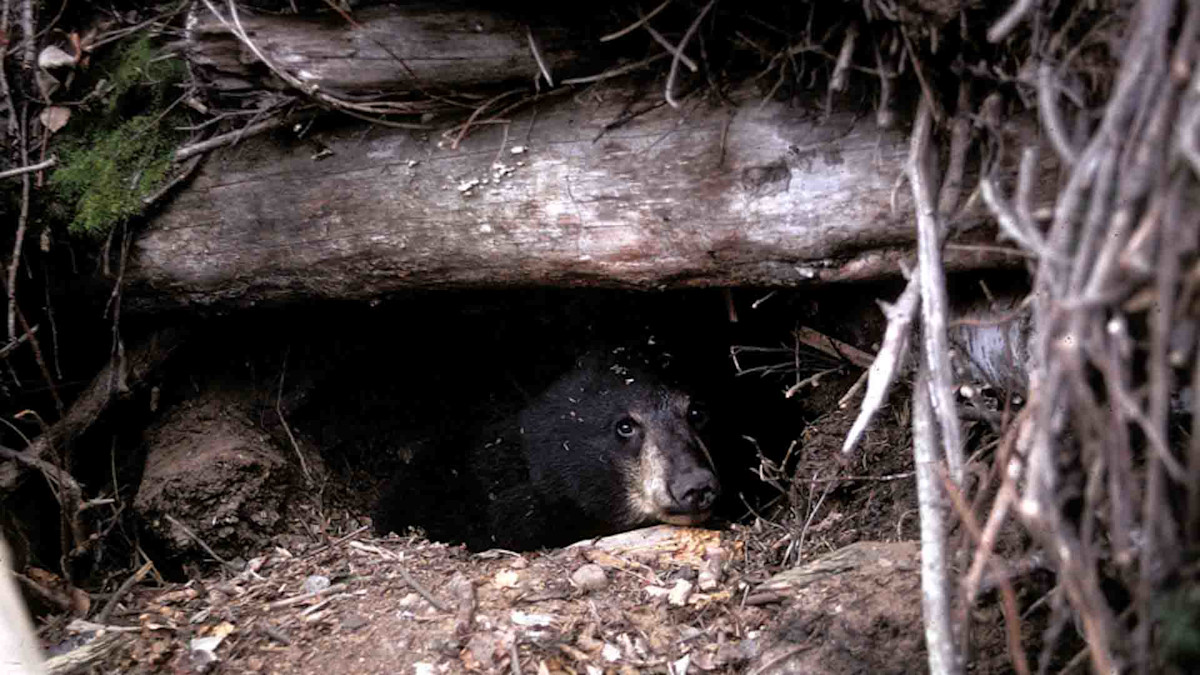

There’s a common misconception that all bears spend their winters curled up in a cozy den, sleeping until spring rolls around. While that explanation isn't entirely wrong, black bear winter behavior is much more complex than simply going to sleep for a few months.
Across their range, black bears use winter dens to conserve energy during periods when natural food becomes scarce. How long they remain denned can vary considerably depending on climate, food availability, sex, and reproductive status. Bears living in colder northern climates may spend several months in a den, while bears in warmer portions of their range may remain active for much of the winter. Even the term "hibernation" isn't as straightforward as it sounds.
So, do black bears really hibernate? Well, it depends on how you define hibernation.
Hibernation VS. Torpor
Black bears certainly fit the loose definition of hibernation, which relates to bears retreating to a den and spending much of the winter in a dormant state. Physiologically, however, their winter dormancy differs from the deep hibernation seen in animals like chipmunks and woodchucks. Instead, black bears enter a state known as torpor, which Great Smoky Mountains National Park describes as “a lighter and less intense form of hibernation.”
During torpor, a bear undergoes several physiological changes that allow it to conserve energy through the winter. According to the New Jersey Division of Fish and Wildlife, “their heart rate and respiratory rate slow and their body temperature slightly drops, but not as much as in true hibernators.” This distinction is important because true hibernators experience a much more dramatic decrease in body temperature and are generally more difficult to awaken. Black bears, on the other hand, can wake and become active relatively quickly if disturbed.
What makes this especially interesting is the size of the animal. Most hibernating species are small mammals weighing only a few ounces, while an adult black bear can weigh several hundred pounds. According to Great Smoky Mountains National Park, exactly how such a large mammal is capable of undergoing this process is still not fully understood.
Not all black bears spend the same amount of time in torpor. Climate, food availability, sex, and reproductive status can all influence when a bear enters its den and how long it stays there. According to the North Carolina Wildlife Resources Commission, black bears in their state can enter their dens as early as mid-October or as late as January and emerge anywhere from February to April.
In warmer climates, some bears may not enter torpor at all. The Fish & Wildlife Foundation of Florida notes that this is especially true for males when food remains readily available. But there is one group of bears that has a particularly important reason to den each winter: pregnant females.
Breeding Cycles
According to Bear Hunting Magazine, black bear breeding season occurs in early to mid-summer, usually June and July, several months before females enter their winter dens. During this period, females may experience multiple estrous cycles and breed with multiple males. For a deeper dive into black bear breeding behavior, check out Clay Newcomb’s article here.
But breeding in the summer doesn't necessarily mean a female is pregnant right away. Black bears use a reproductive strategy known as delayed implantation, and this is where things get really interesting.
Breeding in the summer doesn't mean a female immediately begins developing cubs. Fertilized eggs develop into tiny embryos called blastocysts before suspending further development. According to a Vermont conservation group, the blastocysts remain dormant for several months while the female spends the fall building up fat reserves. If she has accumulated enough fat to support herself and her cubs through winter, the blastocysts implant in the uterine wall around November or December, which will align with her denning. If she hasn't, implantation may not occur, and she won't give birth that winter.
Once implantation occurs, development progresses rapidly. From there, the actual period of fetal development lasts only about 60 days, with cubs typically born in their mother's winter den in mid-to-late January or early February.
According to Northern Woodlands, black bears typically give birth to two or three cubs, although litters can range from one to five. The newborns are “tiny, blind, almost hairless cubs. Measuring about nine inches long and weighing in at roughly one-half pound, each cub is about the size of a chipmunk.” For the next several months, the cubs depend entirely on their mother for food and warmth.
Same Mom, Different Dads
Now, remember those multiple estrous cycles during breeding season and the litter of multiple cubs born months later? Well, that brings us to one of my favorite facts about black bear reproduction. Cubs from the same litter can have different fathers. That's right, one litter, multiple baby daddies.
One study that examined black bear reproduction documented cases of cubs within the same litter having different fathers. This phenomenon, known as multiple paternity, occurs when a female mates with more than one male during the breeding season, and eggs are fertilized by sperm from different males. This means that two cubs born to the same mother at the same time can actually be half-siblings rather than full siblings. Black bear mothers typically stay with their cubs for 16 to 17 months, even spending a second winter denned alongside their yearlings. By the following spring or early summer, the young bears separate from their mother and begin life on their own, allowing her to breed again. This nearly two-year reproductive cycle means healthy female black bears generally produce litters every other year.
Final Thoughts
While their winter dormancy differs from the deep hibernation of smaller mammals, black bears have developed remarkable adaptations that allow them to survive months with little to no food or water. And depending on where they live, some may not need to den at all. From their ability to conserve energy to their unusual reproductive strategies, there's a lot more to black bear biology than simply sleeping through the winter.
Image via North American Bear Center
Stay in the loop with The MeatEater Newsletter
Shop

Related

Black Bear
Why We Love Spring Black Bear Hunting

Black Bear
Four Ways to Kill a Fall Black Bear